
Bible Mind Map: How to See a Whole Catholic Bible Book on One Page
Short answer: A Bible mind map is a one-page diagram with a book's main theme in the center and branches for its structure, key people, places and verses. It lets you see how a whole book fits together before reading verse by verse, and it helps Catholic readers connect every book to Christ.
What is a Bible mind map?
A mind map starts with one idea in the middle of a page and grows outward in branches. Applied to Scripture, the center is the book (or a theme like the Covenant) and the branches hold what you need to read it well: the outline, the main characters, the places, the key verses and a question to carry into prayer.
It is not a replacement for the text. It is the view from the hill before you walk the path. Many readers get lost in Leviticus or Isaiah because they cannot tell where they are in the book. A map answers that in ten seconds.
Why does a one-page map help you read the Bible?
Three reasons show up again and again when people study this way:
- You see the structure first. Knowing that Deuteronomy is three speeches of Moses, or that Matthew has five great teaching blocks, turns a long book into a handful of scenes.
- You remember more. Writing a few words per branch forces you to choose what matters, and choosing is what fixes it in memory.
- You keep Christ in view. The Second Vatican Council taught that the faithful should read Scripture often, quoting St. Jerome: "ignorance of the Scriptures is ignorance of Christ" (Dei Verbum, 25). A branch titled "Connection to Christ" keeps that question on the page.
How do you build a Bible mind map for one book?
Use a landscape or portrait page and a pencil first. Then follow these steps:
- Write the book and its theme in the center. One short phrase, such as "Deuteronomy: remember, love, obey."
- Add the passage and size. Chapters, and the span of the story, so you know the scale.
- Draw 4 to 6 main branches for the structure. Use the book's own divisions, not your guesses. A reliable Catholic study Bible or the introductions on the USCCB Bible site will show them.
- Attach people and places to the branch where they appear.
- Pick two or three key verses and copy them word for word.
- Add a Catholic branch. Where is this book heard at Mass or in the Liturgy of the Hours? Which Catechism paragraphs quote it?
- End with one reflection question in your own words.
Keep each branch to a few words. If a branch needs a paragraph, it is a note, not a map.
What does a finished example look like? Psalms
The Psalms are a good test because 150 poems look shapeless until you see how they are gathered. The traditional arrangement divides them into five books:
| Part | Psalms | Number of psalms |
|---|---|---|
| Book I | 1 to 41 | 41 |
| Book II | 42 to 72 | 31 |
| Book III | 73 to 89 | 17 |
| Book IV | 90 to 106 | 17 |
| Book V | 107 to 150 | 44 |
Each of the first four books closes with a short blessing of praise, and Psalm 150 closes the whole collection with a final "Praise the Lord." A mind map of Psalms therefore has five main branches, then side branches for the kinds of psalm: praise, lament, thanksgiving, royal and messianic psalms. One practical note: Catholic Bibles differ on numbering. Modern translations such as the New American Bible follow the Hebrew numbering, while the Douay-Rheims and older liturgical books follow the Greek and Latin numbering, which is usually one number lower for Psalms 10 to 147.
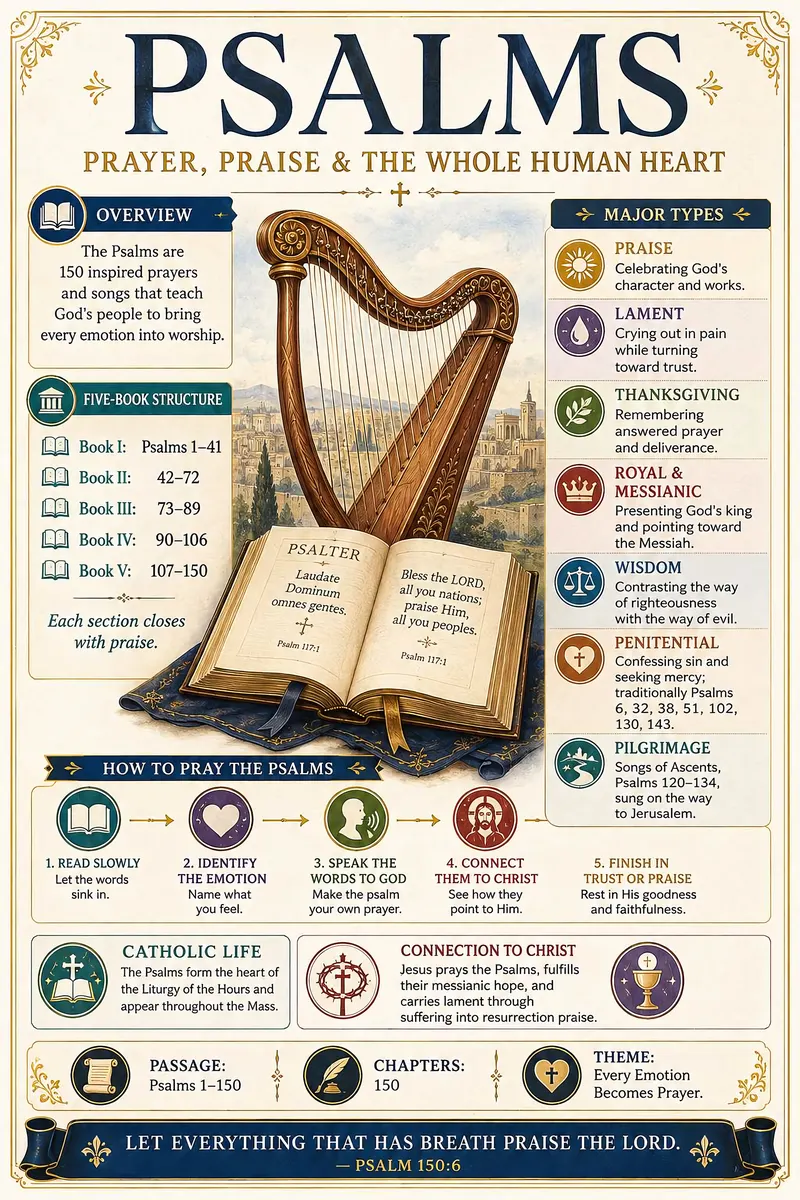
The Catholic branch is easy here: the Church sings the Psalms in the Liturgy of the Hours and a psalm is sung as the responsorial at every Sunday Mass.
What does a second example look like? Matthew
Matthew has a clear skeleton. Its teaching is gathered into five blocks: the Sermon on the Mount (chapters 5 to 7), the mission discourse (10), the parables of the Kingdom (13), the discourse on the community (18) and the final discourse on the end times (24 to 25). Each block ends with a similar phrase: "when Jesus had finished these sayings." Many commentators see a deliberate echo of the five books of Moses. The Gospel closes with the promise "I am with you always, until the end of the age" (Matthew 28:20), which makes a natural bottom line for the map.
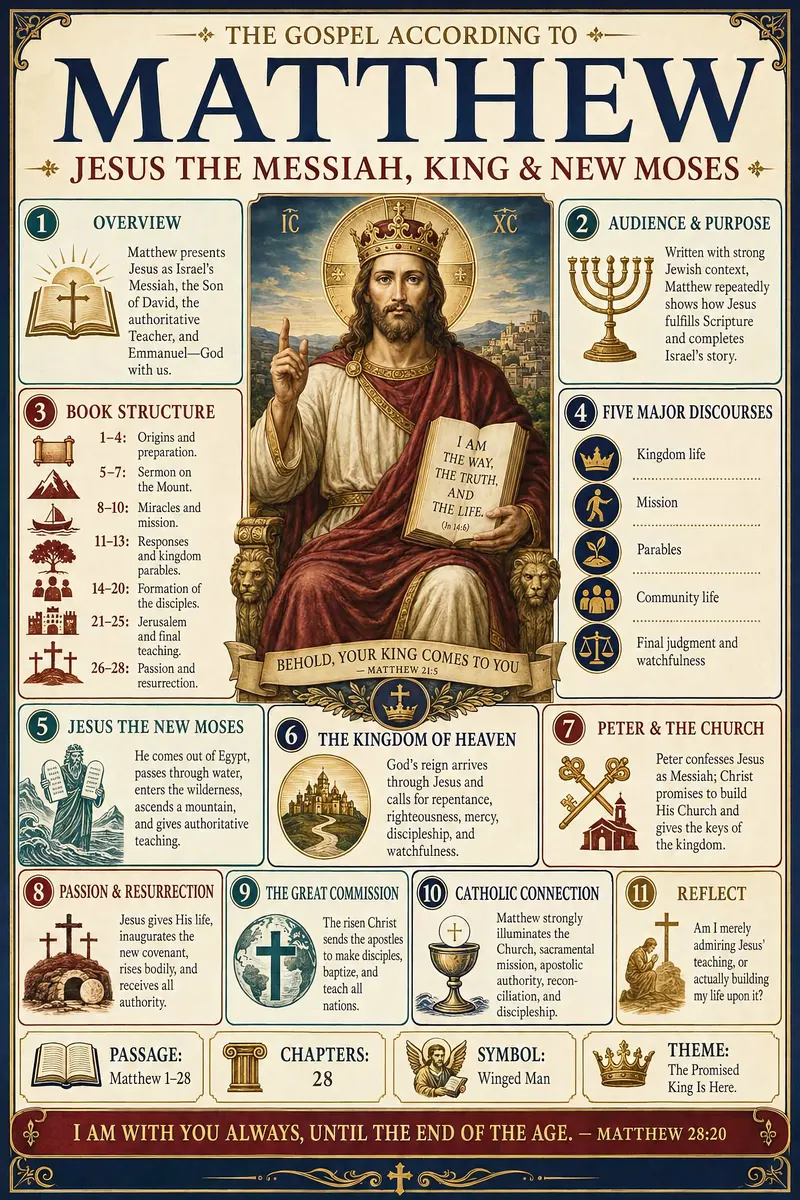
Notice what the map does: it shows the five blocks and the Passion and Resurrection at one glance, so when you later read Matthew 13 you already know where you stand.
What mistakes should you avoid?
- Copying a commentary. A map is your summary, not a paste of someone else's page.
- Too many branches. Past eight or nine, the eye stops reading.
- Skipping the text. Always read the book after you map it. The map is a guide, not the destination.
- Treating a guess as doctrine. If you are unsure about an interpretation, mark it with a question mark and check the Catechism or a trusted Catholic commentary.
Where can you find ready-made Bible mind maps?
You can build every map by hand, and for one or two books that is a great exercise. For all 73 books it takes months. The Catholic Bible Maps guide offers one illustrated page per book, from Genesis to Revelation, each with overview, structure, key verses, Catholic connection and a reflection question, so you can read with the page in front of you. The two pages above come straight from it.