
Jesus' Family Tree in the Bible: What Matthew 1 and Luke 3 Teach Catholics
Short answer: Jesus' family tree appears twice in the Bible: Matthew 1:1-17 traces it from Abraham to Jesus in three groups of fourteen generations, and Luke 3:23-38 traces it back from Jesus to Adam and to God. Both pass through King David, and both reach Jesus through Joseph, the husband of Mary.
Bible text and notes checked against the New American Bible on the USCCB site.
Where is Jesus' family tree in the Bible?
Jesus' family tree appears twice in the New Testament:
- Matthew 1:1-17, at the very start of the New Testament. It opens with "The book of the genealogy of Jesus Christ, the son of David, the son of Abraham."
- Luke 3:23-38, right after the baptism of Jesus and before his ministry begins.
The two lists do not look the same. Matthew walks forward, from Abraham down to Jesus. Luke walks backward, from Jesus up to Adam and to God. Reading them side by side is one of the best ways to see what each Gospel wants to say about who Jesus is.
What does Matthew's genealogy say?
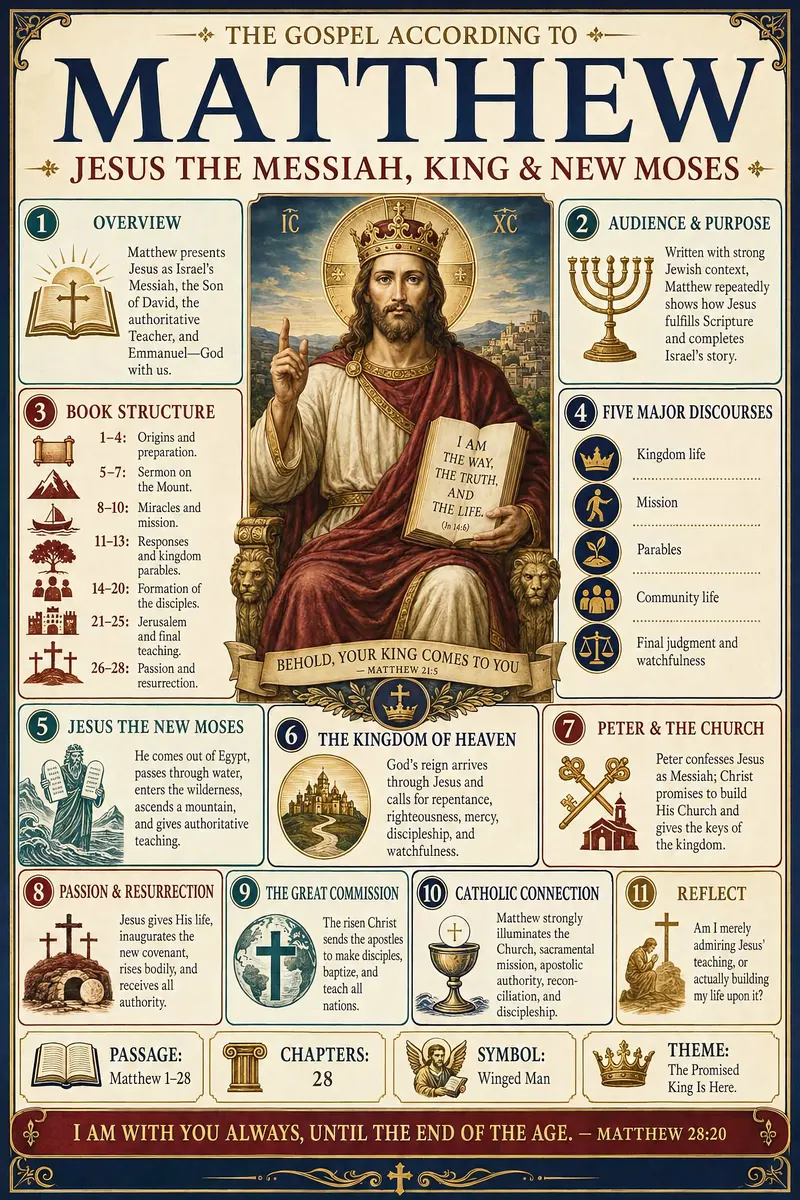
Matthew arranges the family in three blocks. In Matthew 1:17 he sums it up: "from Abraham to David is fourteen generations; from David to the Babylonian exile, fourteen generations; from the Babylonian exile to the Messiah, fourteen generations."
The three blocks follow the story of Israel:
- Abraham to David: the patriarchs, Judah, and the line that leads to King David.
- David to the exile: the kings of Judah, from Solomon down to Jechoniah "at the time of the Babylonian exile."
- The exile to Jesus: Shealtiel, Zerubbabel and names found in no Old Testament genealogy, ending with "Jacob the father of Joseph, the husband of Mary. Of her was born Jesus who is called the Messiah."
Why fourteen? The New American Bible note on Matthew 1:17 says Matthew is concerned with fourteen generations "probably because fourteen is the numerical value of the Hebrew letters forming the name of David." The same note points out that three kings of Judah, Ahaziah, Joash and Amaziah, were left out of the second block. The count is a way of teaching, not a complete census.
Why does David come before Abraham in the first verse? The note on Matthew 1:1 explains that David "is placed first in order to emphasize that Jesus is the royal Messiah."
Which women are named in Jesus' family tree?
Matthew names four women before Mary:
- Tamar, the mother of Perez and Zerah (Matthew 1:3)
- Rahab, the mother of Boaz (Matthew 1:5)
- Ruth, the mother of Obed (Matthew 1:5)
- The wife of Uriah, Bathsheba, the mother of Solomon (Matthew 1:6)
The New American Bible note says these women "bore their sons through unions that were in varying degrees strange and unexpected." It then says all of this points ahead to the most unexpected birth of all: "the Messiah's birth of a virgin mother; the age of fulfillment is inaugurated by a creative act of God."
For many readers this is the most moving part of the list. God worked through real families, with real histories, to bring his Son into the world.
How is Luke's genealogy different?
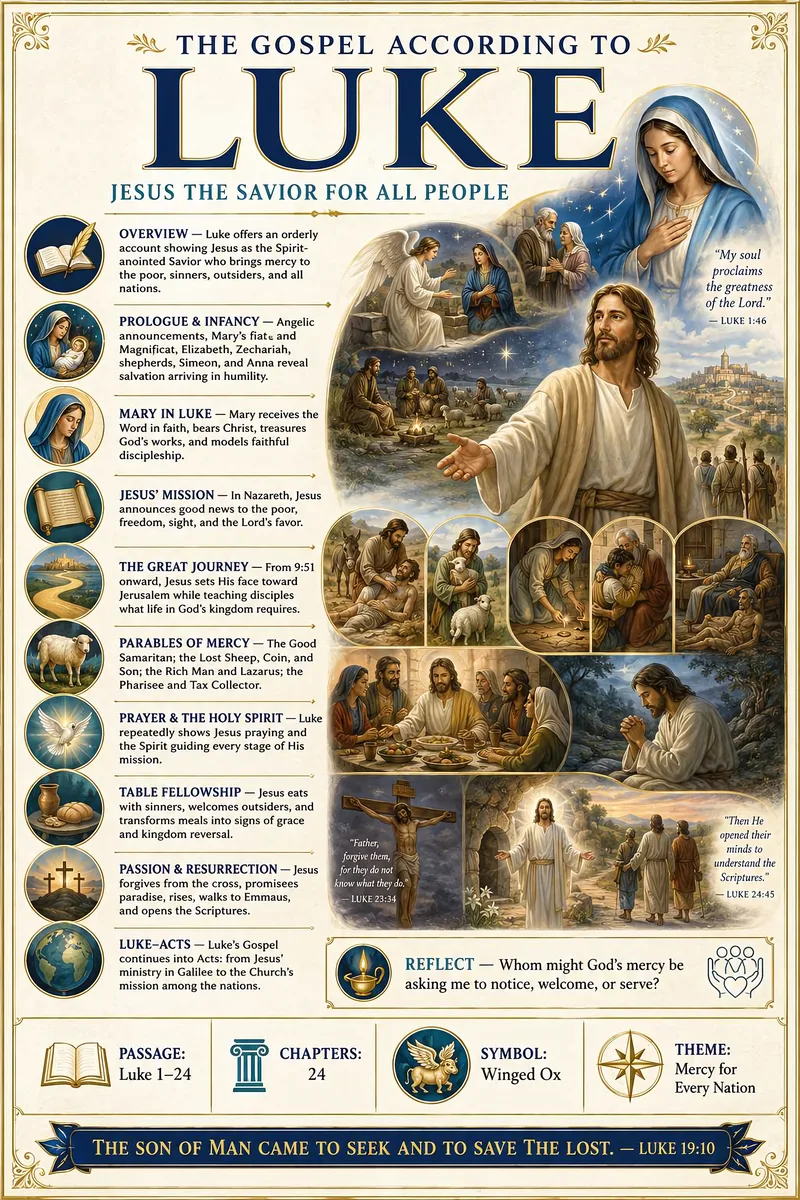
Luke 3:23 begins: "When Jesus began his ministry he was about thirty years of age. He was the son, as was thought, of Joseph, the son of Heli." From there the list climbs back through David, Judah, Abraham and Noah, and ends in Luke 3:38 with "the son of Enos, the son of Seth, the son of Adam, the son of God."
A few differences stand out when you compare the two:
- Direction: Matthew goes from Abraham down to Jesus; Luke goes from Jesus up to Adam.
- Starting point: Matthew starts with Abraham; Luke goes all the way back to Adam and to God.
- Son of David: Matthew follows King Solomon (Matthew 1:6-7); Luke follows David's son Nathan (Luke 3:31).
- Joseph's father: Matthew names Jacob (Matthew 1:16); Luke names Heli (Luke 3:23).
The New American Bible note explains the purpose of each list. Matthew begins with Abraham "to emphasize Jesus' bonds with the people of Israel," while "Luke's universalism leads him to trace the descent of Jesus beyond Israel to Adam and beyond that to God (Lk 3:38) to stress again Jesus' divine sonship." On the choice of Nathan, the note says Luke traces Jesus' Davidic ancestry "through the prophet Nathan (see 2 Sm 7:2) rather than through King Solomon."
If Jesus was born of a virgin, why trace Joseph's line?
This is the question most people ask. Matthew answers it in the very next story. An angel tells Joseph in a dream: "Joseph, son of David, do not be afraid to take Mary your wife into your home. For it is through the holy Spirit that this child has been conceived in her" (Matthew 1:20). Joseph obeys and names the child Jesus (Matthew 1:25).
The note on Matthew 1:18-25 puts it simply: "The natural genealogical line is broken but the promises to David are fulfilled; through Joseph's adoption the child belongs to the family of David."
The Catechism says the same in paragraph 437: God called Joseph to take Mary as his wife "so that Jesus, 'who is called Christ', should be born of Joseph's spouse into the messianic lineage of David."
When do Catholics hear Jesus' genealogy at Mass?
Twice in the Advent and Christmas season this year:
- Thursday, December 17, 2026 (Thursday of the Third Week of Advent): the Gospel is Matthew 1:1-17. The first reading that day is Genesis 49:2, 8-10, Jacob's blessing over Judah: "The scepter shall never depart from Judah."
- The Vigil Mass of Christmas: the Gospel is Matthew 1:1-25, with the shorter option Matthew 1:18-25.
December 17 is a good day to read the whole list slowly at home before Mass, so the names are familiar when you hear them proclaimed. If you are following a plan this season, our Catholic Advent Bible reading plan walks through the promises that lead to Bethlehem.
How can you study Jesus' family tree at home?
A simple way to do it in one sitting:
- Read Matthew 1:1-17 out loud. Mark Abraham, David and the exile, the three turning points.
- Underline the four women. Then follow the cross references printed with the text: Genesis 38:29-30 for Tamar's sons, Ruth 4:18-22 for Boaz and Obed, 2 Samuel 12:24 for Solomon.
- Read Luke 3:23-38 and circle the names you already met in Matthew.
- Finish with Matthew 1:18-25, where the list meets Joseph, Mary and the child named Emmanuel, "God is with us."
The genealogy draws on books from all over the Old Testament: Genesis, Ruth, Samuel, Kings and Chronicles. It helps to see each of those books on one page before you go looking. The Catholic Bible Maps kit has an illustrated page for each of the 73 books of the Catholic Bible, so you can see where Ruth, David or the exile fit in the whole story.