
Book of Genesis Summary for Catholics: Outline, Themes and Key Stories
Short answer: Genesis is the first book of the Bible. It has two parts: the story of the nations (creation, the fall, the flood and Babel) and the story of Abraham's family, from Abraham and Sarah through Isaac, Jacob and Joseph, ending with Israel in Egypt. The Catechism begins its teaching on creation with its first verse.
Everything below comes from the Introduction to Genesis in the New American Bible, Revised Edition, published by the USCCB, and from the Catechism of the Catholic Church. Where the notes say there is no firm evidence, we say so too.
What is the Book of Genesis about?
Genesis is the first book of the Pentateuch, the first five books of the Bible: Genesis, Exodus, Leviticus, Numbers and Deuteronomy. The USCCB introduction explains that the English title comes from the Greek of Genesis 2:4, literally "the book of the generation (genesis) of the heavens and earth." In the Jewish Scriptures the book is named after its first Hebrew word, Bereshit, "in the beginning."
The Catechism opens its teaching on creation with the same line: "In the beginning God created the heavens and the earth." It adds that "Holy Scripture begins with these solemn words" (CCC 279). So if you are wondering where the whole Bible starts, it starts here.
How is the Book of Genesis organized?
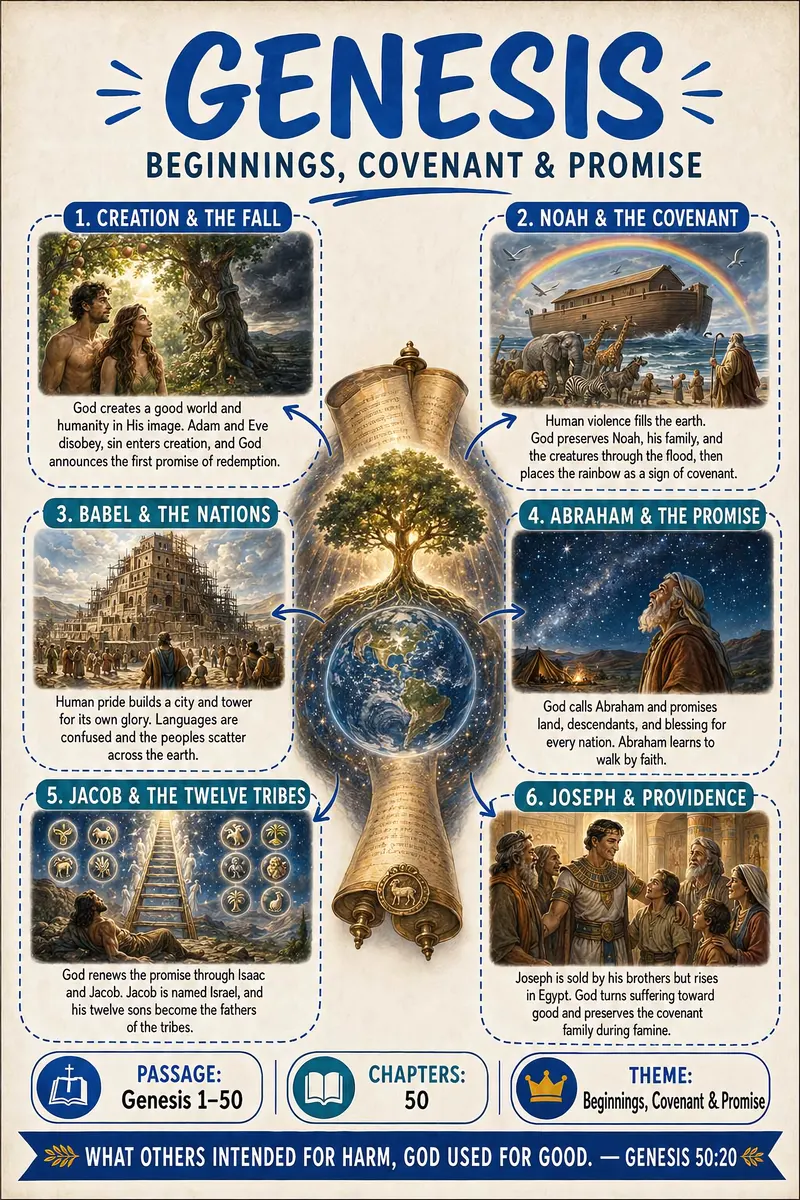
The USCCB introduction says the book has two major sections:
- The story of the nations (Genesis 2:4 to 11:9). The creation and expansion of the human race. This section deals with God and the nations.
- The story of Abraham and his descendants (Genesis 11:10 to 50:26). This section deals with God and one particular nation, Israel.
Before both sections comes the opening account of creation (Genesis 1:1 to 2:3). The introduction notes two themes there that run through the whole book: the command to the first couple to have children and to possess land (Genesis 1:28). In the second half of Genesis those themes return as God's promises of descendants and land to the ancestors.
The same notes list a repeated phrase, "this is the story; these are the descendants" (Hebrew toledot), which appears five times in each section. It works like a chapter heading and helps you see where one story ends and the next begins.
What happens in Genesis 1 to 11?
These chapters tell of creation, the flood and renewed creation. The notes say the seven-day account shows "a God whose mere word creates a beautiful universe in which human beings are an integral and important part."
The USCCB notes also give a careful word on how to read these chapters. They say the stories are "neither history nor myth," and that the best term is "creation-flood story." Ancient writers used narrative for questions we would call philosophical and theological. The stories answer questions such as why there is rebellion, why there is marriage, and why there are many peoples and languages.
The Catechism picks up the same questions. It says catechesis on creation concerns "the very foundations of human and Christian life," because it answers: "Where do we come from?" and "Where are we going?" (CCC 282).
What does Genesis teach about the human person and sin?
Three short teachings from the Catechism are a good companion to your first reading:
- Every person has dignity. Being made in God's image, the human individual is "not just something, but someone" (CCC 357).
- The first sin was a loss of trust. The man, tempted by the devil, "let his trust in his Creator die in his heart" and disobeyed (CCC 397).
- Sin has wide consequences. The harmony of original justice is broken, and "death makes its entrance into human history" (CCC 400).
The Catechism does not leave the story there. It quotes St. Paul, who contrasts "the universality of sin and death with the universality of salvation in Christ" (CCC 402). The USCCB notes make the same link: Paul reads Jesus as the New Adam (Romans 5:14 and 1 Corinthians 15:22, 24), whose obedience brings life just as the old Adam's disobedience brought death.
Who are Abraham, Isaac, Jacob and Joseph?
From Genesis 11 on, the book follows one family. The notes describe the cycles this way:
- Abraham and Sarah (Genesis 11:27 to 25:18). Abraham will not receive land and children the way the nations do: he is old and his wife is childless. They must live with God "in trust and obedience" until Isaac is born. The notes call Abraham's faith "a wonderful example" for a later generation.
- Isaac and Jacob (Genesis 25:19 to 36:43). Jacob takes his brother Esau's right as firstborn, flees to Paddan-Aram, is blessed with wealth and sons, and returns and is reconciled with Esau. With twelve sons, he is given the name Israel.
- Joseph (Genesis 37:1 to 50:26). Sold into slavery in Egypt by his brothers, Joseph rises to be second only to Pharaoh. When famine brings his brothers to Egypt, he tests whether they have repented. At the end of Genesis the whole family of Jacob is in Egypt, which prepares for the Book of Exodus.
As for dates, the notes say scholars have traditionally placed the ancestral stories in the first half of the second millennium B.C. They also say there is no direct outside evidence that confirms or disproves the stories, and that it is reasonable to accept the Bible's own chronology that the patriarchs lived well before the Exodus, which is generally dated in the thirteenth century B.C. For the full sweep of eras, see our Catholic Bible timeline.
How does Genesis point to Jesus?
The Catechism says the Church has always shown the unity of God's plan in both Testaments "through typology," which sees in the works of the Old Covenant "prefigurations of what he accomplished in the fullness of time in the person of his incarnate Son" (CCC 128).
The USCCB introduction lists links you can look up yourself:
- John 1, "In the beginning was the word," alludes to Genesis 1:1 to show that Jesus is creating a new world.
- Romans 4 cites Abraham as righteous in God's eyes centuries before the Law was given at Sinai.
- Isaiah 51:2 holds up Abraham and Sarah as a model for a discouraged community, for though only a couple, they became a great nation.
How can you read Genesis with a pencil and one page at a time?
Genesis has 50 chapters, so it helps to read it in pieces. One simple plan:
- Read Genesis 1:1 to 2:3 in one sitting and underline each time God speaks.
- Read chapters 2 to 11 over a few days, one story per day.
- Read the Abraham chapters (12 to 25), then Isaac and Jacob, then Joseph, and write one sentence about each family member.
Seeing each book on a single page makes this easier. The Catholic Bible Maps kit has an illustrated page for each of the 73 books of the Catholic Bible, including Genesis and the Exodus that follows it, so you can keep the story of the whole Bible in view while you read. When you finish Genesis, you may also like our guide to the 73 books of the Catholic Bible.
Sources
- USCCB, Introduction to Genesis (NABRE)
- Catechism of the Catholic Church, paragraph 128
- Catechism of the Catholic Church, paragraph 279
- Catechism of the Catholic Church, paragraph 282
- Catechism of the Catholic Church, paragraph 357
- Catechism of the Catholic Church, paragraph 397
- Catechism of the Catholic Church, paragraph 400
- Catechism of the Catholic Church, paragraph 402