
Catholic Bible Timeline: The Story of Scripture in Order, With Dates
Short answer: A Catholic Bible timeline runs from creation and the patriarchs through the Exodus, the kings and prophets, the exile in Babylon (Jerusalem destroyed in 587/586 B.C.), the return under Cyrus (538 B.C.), the Maccabean revolt (175 to 134 B.C.), the life of Jesus and the early Church.
Every date below comes from the notes and book introductions of the New American Bible, Revised Edition, published by the USCCB, and every Church teaching from the Catechism of the Catholic Church. Where those notes give no firm date, we leave the era undated instead of guessing.
What is a Catholic Bible timeline?
A Bible timeline puts the story of Scripture in the order it happened, so you can see where each book fits. A Catholic timeline does two more things:
- It includes all 73 books, so the era of Tobit, Judith and the Maccabees is not missing between the prophets and the Gospels.
- It reads history as one plan of God. The Catechism says that "the New Testament lies hidden in the Old and the Old Testament is unveiled in the New" (CCC 129).
The Catechism itself walks through the same stages: the first covenant with our first parents, the covenant with Noah, the call of Abraham, the formation of Israel, the prophets, and finally Christ (CCC 54 to 65). A timeline is simply those stages drawn on paper.
What are the main eras of the Bible in order?
Here is a simple chart you can copy into a notebook. Read it from top to bottom.
| Era | Approximate date | Where to read |
|---|---|---|
| Creation, the Fall, Noah, Babel | No date (primeval history) | Genesis 1 to 11 |
| Abraham, Isaac, Jacob, Joseph | First half of the second millennium B.C. (traditional dating) | Genesis 12 to 50 |
| Exodus, Sinai, the desert | Generally dated in the 13th century B.C. | Exodus to Deuteronomy |
| Land, judges, kings | No firm date for the early kings | Joshua to 2 Kings |
| Divided kingdom and prophets | Fall of the north 722/721 B.C. | Amos, Hosea, Isaiah |
| Exile in Babylon | Jerusalem destroyed 587/586 B.C. | Jeremiah, Ezekiel, Baruch |
| Return and restoration | Edict of Cyrus 538 B.C. | Ezra, Nehemiah |
| Maccabean revolt | 175 to 134 B.C. | 1 and 2 Maccabees, Daniel |
| Life of Jesus | Born under Herod, who died in 4 B.C. | Matthew, Mark, Luke, John |
| The early Church | First century A.D. | Acts, the letters, Revelation |
Books like Psalms, Proverbs, Wisdom and Sirach do not tell a story in sequence, so they sit beside the timeline rather than on it.
When did Abraham and the patriarchs live?
Genesis has two major sections, according to the USCCB introduction: the creation and expansion of the human race (Genesis 2:4 to 11:9), and the story of Abraham and his descendants (Genesis 11:10 to 50:26).
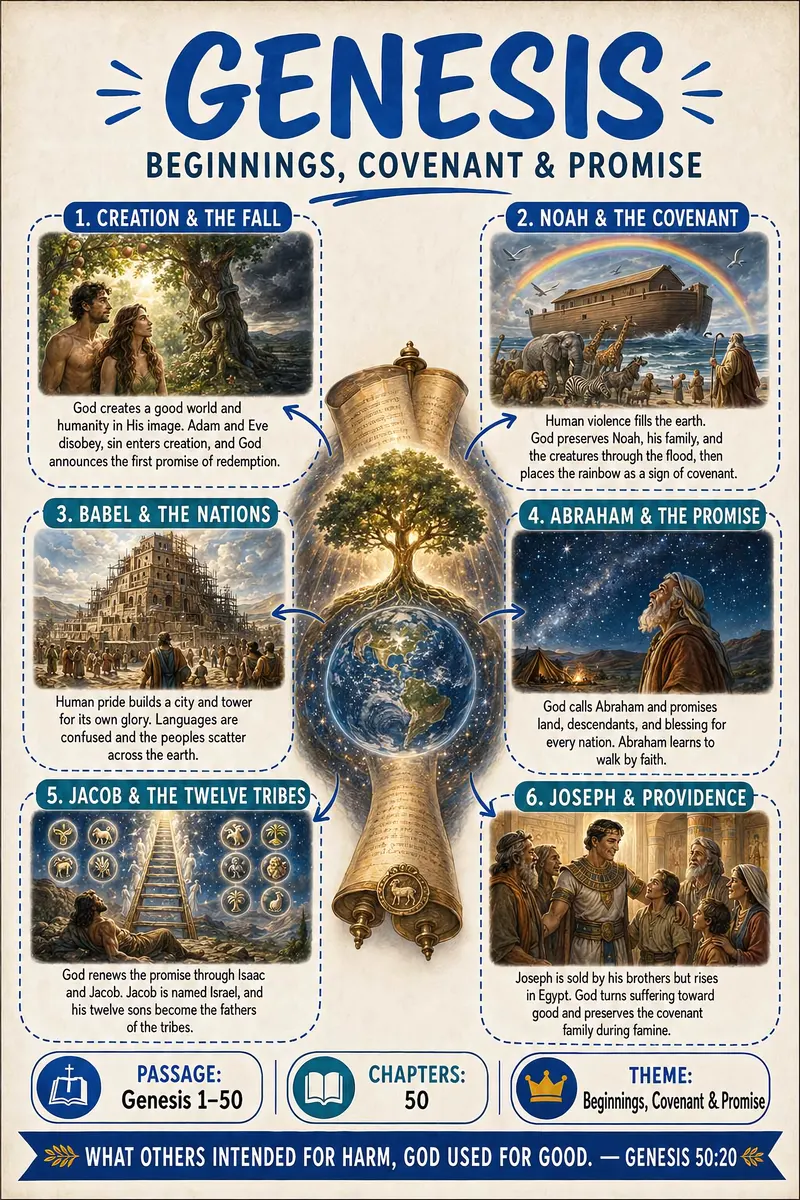
For the patriarchs, the same introduction says that scholars "have traditionally dated them sometime in the first half of the second millennium." It adds that there is no direct evidence outside the Bible either way, and that it is reasonable to accept the Bible's own chronology: the patriarchs lived well before the exodus, which is "generally dated in the thirteenth century" B.C.
The Catechism gives the meaning behind the date. God calls Abram and makes him Abraham, "the father of a multitude of nations" (CCC 59). Then, "After the patriarchs, God formed Israel as his people by freeing them from slavery in Egypt" (CCC 62).
What happened during the kings and the prophets?
This is where the dates become firmer. The USCCB introductions give these markers:
- 786 to 746 B.C.: the reign of Jeroboam II in the north, when Amos preached (Amos introduction).
- 742 B.C.: the death of King Uzziah, when Isaiah's ministry began. It ran at least to the siege of Jerusalem in 701 B.C. (Isaiah introduction).
- 722/721 B.C.: the Northern Kingdom collapsed under Assyria.
- Around 622 B.C.: "the Book of the Law" was discovered in the Jerusalem Temple (Deuteronomy introduction).
The Catechism explains why the prophets matter on any timeline: "Through the prophets, God forms his people in the hope of salvation" (CCC 64). The same paragraph names holy women who kept that hope alive, among them Sarah, Hannah, Judith and Esther, and calls Mary "the purest figure among them."
When was the Babylonian exile and the return?
Two dates frame the exile:
- 598 B.C.: Nebuchadnezzar captured Jerusalem and carried King Jehoiachin into exile (Jeremiah introduction).
- 587/586 B.C.: the destruction of Jerusalem and the loss of the homeland (1 Samuel introduction).
The return begins with Ezra 1:1, "In the first year of Cyrus, king of Persia." The USCCB note explains that his first year as ruler of Babylon was 538 B.C., "the year in which he issued an edict" allowing deported peoples to go home (Ezra 1). Nehemiah later served as governor of Judah, his first term lasting from 445 to 432 B.C. (Nehemiah introduction).
Where do the Maccabees fit between the Testaments?
This is the gap many timelines leave empty, and it is where the deuterocanonical books shine.
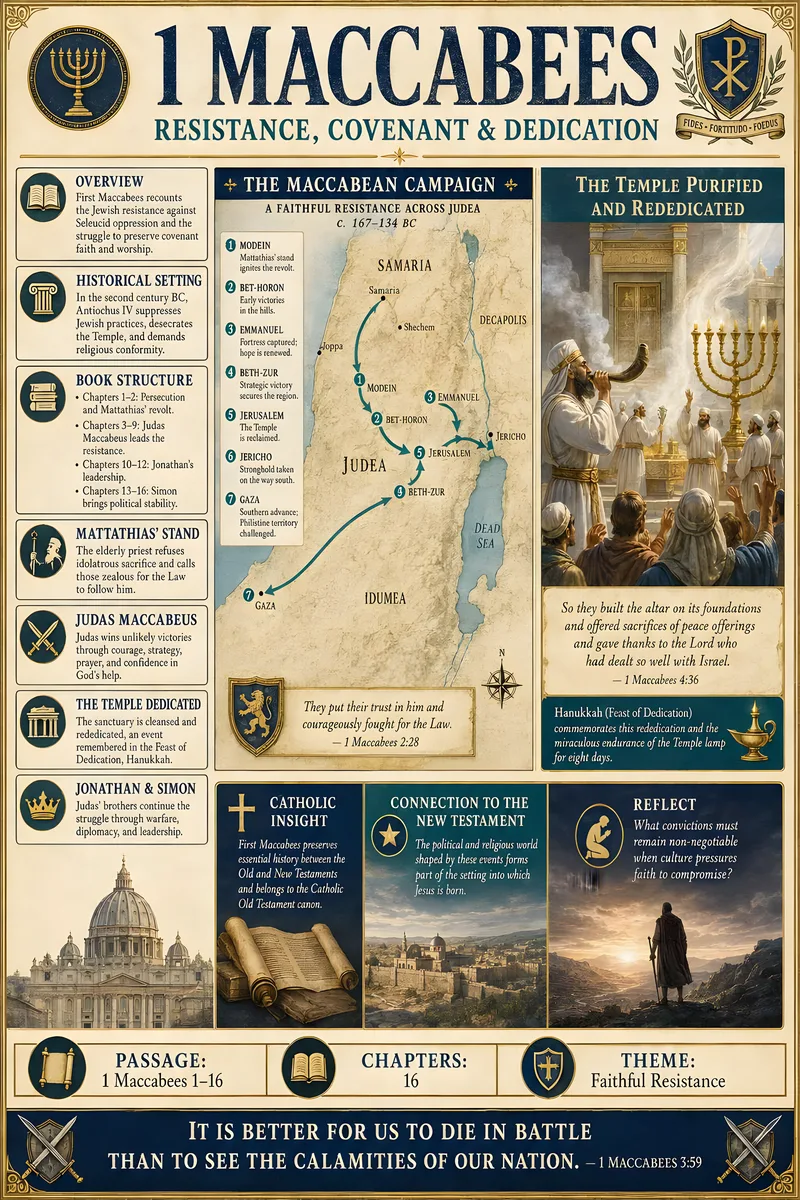
- First Maccabees covers the history "from 175 to 134 B.C." and was written about 100 B.C. (1 Maccabees introduction).
- The Book of Daniel was composed during the persecution of Antiochus IV Epiphanes, dated 167 to 164 B.C. (Daniel introduction).
For the story of the revolt and the rededication of the Temple, see our summary of 1 and 2 Maccabees.
What are the key dates in the life of Jesus?
The Gospels anchor Jesus in real history:
- Matthew 2:1 places his birth "in the days of King Herod." The USCCB note says Herod "reigned from 37 to 4 B.C." (Matthew 2).
- Luke 3:1 dates the preaching of John the Baptist to "the fifteenth year of the reign of Tiberius Caesar." The note places that year between A.D. 27 and 29, and gives Pontius Pilate as prefect of Judea from A.D. 26 to 36 (Luke 3).
- Revelation, in its present form, is dated "probably near the end of the reign of Domitian," A.D. 81 to 96 (Revelation introduction).
The Catechism sums up where the whole line points. In Christ, God "has said everything; there will be no other word than this one" (CCC 65).
How can you use a timeline when you read the Bible?
- Keep the chart in your Bible. Before you start a book, find its era.
- Pair a prophet with his king. Read Amos next to the reign of Jeroboam II, or Isaiah next to King Hezekiah, and the oracles make more sense.
- Do not skip the centuries before Christ. Ezra, Nehemiah and the Maccabees show the world Jesus was born into.
- Try a chronological plan. Our Catholic Bible reading plan guide compares a 365-day chronological plan with other options.
If you learn best by seeing, the Catholic Bible Maps kit gives you one illustrated page for each of the 73 books, like the Genesis and 1 Maccabees pages above, which show the passage, the number of chapters and the theme. Every book gets a picture you can place on your timeline.
Sources
- USCCB, Introduction to Genesis (NABRE)
- USCCB, Introduction to Amos (NABRE)
- USCCB, Introduction to Isaiah (NABRE)
- USCCB, Introduction to Deuteronomy (NABRE)
- USCCB, Introduction to Jeremiah (NABRE)
- USCCB, Introduction to 1 Samuel (NABRE)
- USCCB, Ezra 1 with notes (NABRE)
- USCCB, Introduction to Nehemiah (NABRE)
- USCCB, Introduction to 1 Maccabees (NABRE)
- USCCB, Introduction to Daniel (NABRE)
- USCCB, Matthew 2 with notes (NABRE)
- USCCB, Luke 3 with notes (NABRE)
- USCCB, Introduction to Revelation (NABRE)
- Catechism of the Catholic Church, paragraph 54
- Catechism of the Catholic Church, paragraph 56
- Catechism of the Catholic Church, paragraph 59
- Catechism of the Catholic Church, paragraph 62
- Catechism of the Catholic Church, paragraph 64
- Catechism of the Catholic Church, paragraph 65
- Catechism of the Catholic Church, paragraph 129