
Book of Judith Summary for Catholics: The Story, the Widow Who Trusted God and Why It Is in the Bible
Short answer: The Book of Judith is a 16-chapter Old Testament story of a widow who saves her besieged town. Judith confronts leaders who test God, enters the enemy camp, and Holofernes is killed. The USCCB calls it historical fiction written to praise God as Israel's deliverer. It is one of the seven deuterocanonical books.
Bible text and notes checked against the New American Bible on the USCCB site.
What is the Book of Judith about?
Judith is an Old Testament book of 16 chapters. It tells how God saved his people from a huge foreign army through a widow, not through soldiers.
The USCCB introduction says the book "relates the story of God's deliverance of the Jewish people" and that this was done "by the hand of a female." That phrase comes back again and again, and it is meant to recall the "hand" of God in the Exodus story.
The main people:
- Judith, a beautiful, God-fearing widow of Bethulia. Her name means "Jewish woman."
- Holofernes, the Assyrian general sent to crush the nations that would not join the king's war.
- Uzziah, a ruler of Bethulia, who swears to surrender the city in five days if help does not come.
- Her maid, who stays beside her through the whole mission.
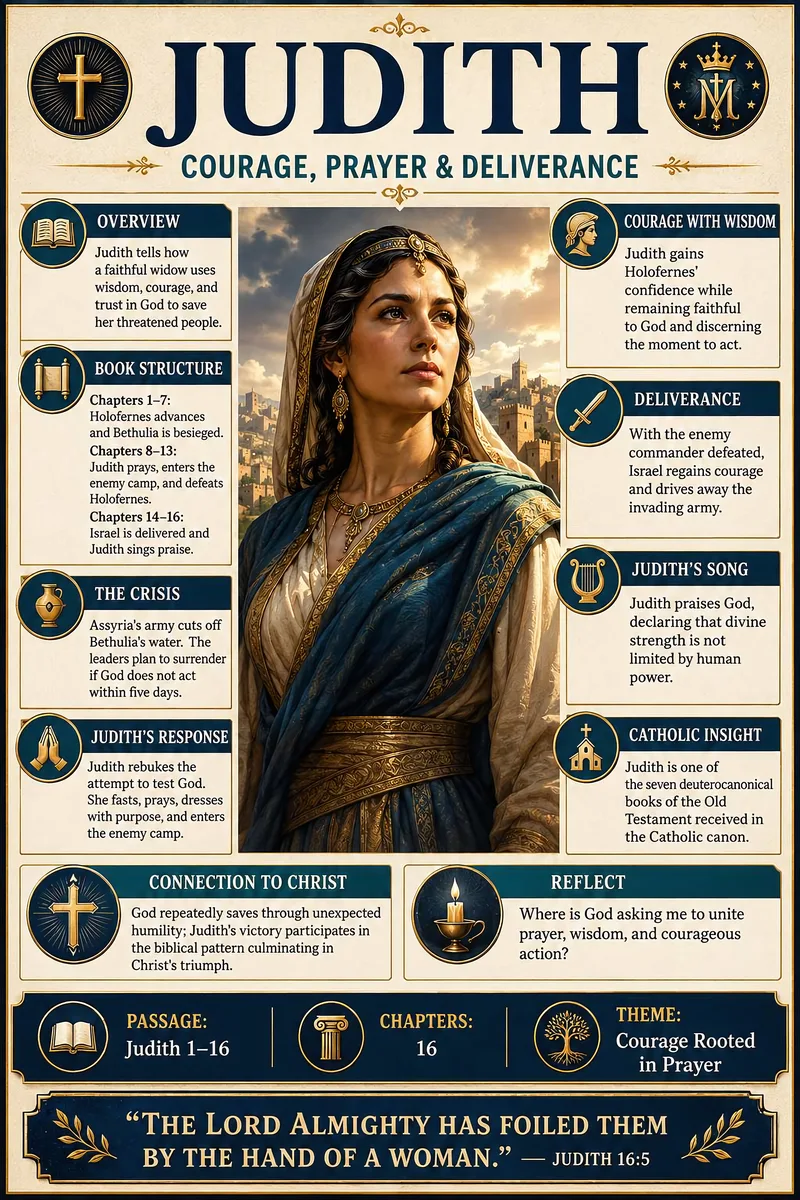
What happens in the story, part by part?
The New American Bible divides the book into five parts:
- Assyrian threat (1:1 to 3:10). Nebuchadnezzar's army moves against the nations of the west.
- Siege of Bethulia (4:1 to 7:32). The town is cut off, and the people run short of water.
- Judith, instrument of the Lord (8:1 to 10:10). Judith confronts the leaders and prepares for her mission.
- Judith goes out to war (10:11 to 13:20). She enters the enemy camp, and Holofernes is killed.
- Victory and thanksgiving (14:1 to 16:25). Israel is freed, and Judith sings a hymn.
Who is Judith, and why does she speak to the leaders of Bethulia?
Chapter 8 introduces her. Her husband, Manasseh, died during the barley harvest. She had been a widow "for three years and four months," living in a tent on her roof in sackcloth, and she "fasted all the days of her widowhood" except on sabbaths and feast days (8:4 to 6). Scripture adds: "No one had a bad word to say about her, for she feared God greatly" (8:8).
When she hears that Uzziah promised to surrender in five days, she summons the elders and tells them: "Who are you to put God to the test today, setting yourselves in the place of God in human affairs?" (8:12). She adds: "Do not impose conditions on the plans of the Lord our God" (8:16).
Then she calls the people to trust and to pray: "So while we wait for the salvation that comes from him, let us call upon him to help us" (8:17).
What happens when Judith goes to Holofernes?
Chapter 13 is the turning point. Alone in the tent with Holofernes, who is drunk with wine, Judith prays silently: "Strengthen me this day, Lord, God of Israel!" (13:7). She strikes and cuts off his head.
She and her maid leave the camp as if going out to pray, as they had done on earlier days, and return to Bethulia. At the gate she cries: "God, our God, is with us" (13:11). She then tells the people: "The Lord struck him down by the hand of a female!" (13:15).
The USCCB introduction notes that the book is "filled with double entendres and ironic situations." It also compares Judith to Jael and Deborah from the Book of Judges, who also act in a military crisis.
Is the Book of Judith history?
The USCCB introduction is direct about this. It says the work "may have been written around 100 B.C." and that, given its mixed-up details, "the simple conclusion" is that it is "historical fiction, written to exalt God as Israel's deliverer from foreign might, not by an army, but by means of a simple widow."
Some examples it gives: Nebuchadnezzar is called an Assyrian king, though he ruled Babylon, and Nineveh is named as the Assyrian capital though it fell in 612 B.C. Bethulia is an unidentified town.
So the book is read for its message, not as a military record. Its message is that God is faithful to those who trust him.
Why is Judith in the Catholic Bible but not in many Protestant Bibles?
According to the USCCB introduction, "the rabbis did not count Judith among their scriptures, and the Reformation adopted that position." But "the early Church, however, held this book in high honor."
- St. Clement of Rome, a first-century pope, "proposes Judith as an example of courageous love."
- St. Jerome holds her up as an example of a holy widow and a type of the Church, and describes Mary as a new Judith.
- The Council of Trent (1546) included Judith in the canon.
Today the Catechism of the Catholic Church (120) lists Judith, with Tobit, among the books of the Old Testament canon. Judith is one of the seven deuterocanonical books. If you want the full list, see our guide to the deuterocanonical books, or read the companion Book of Tobit summary.
How does Judith end, and what can we take from it?
After the victory, Judith sings: "Strike up a song to my God with tambourines" (16:1). She dedicates to God the things taken from Holofernes (16:19), and the people celebrate for three months in Jerusalem (16:20).
Judith then goes back to her estate. "Many wished to marry her, but she gave herself to no man all the days of her life" (16:22). She lived to the age of one hundred and five, set her maid free, and "the house of Israel mourned her for seven days" (16:23 to 24). The last verse says that during her lifetime and long after, "no one ever again spread terror among the Israelites" (16:25).
A few things readers often take from it:
- Fasting and prayer come before action.
- Do not test God or set deadlines for him (8:12 to 16).
- God can work through the people the world overlooks.
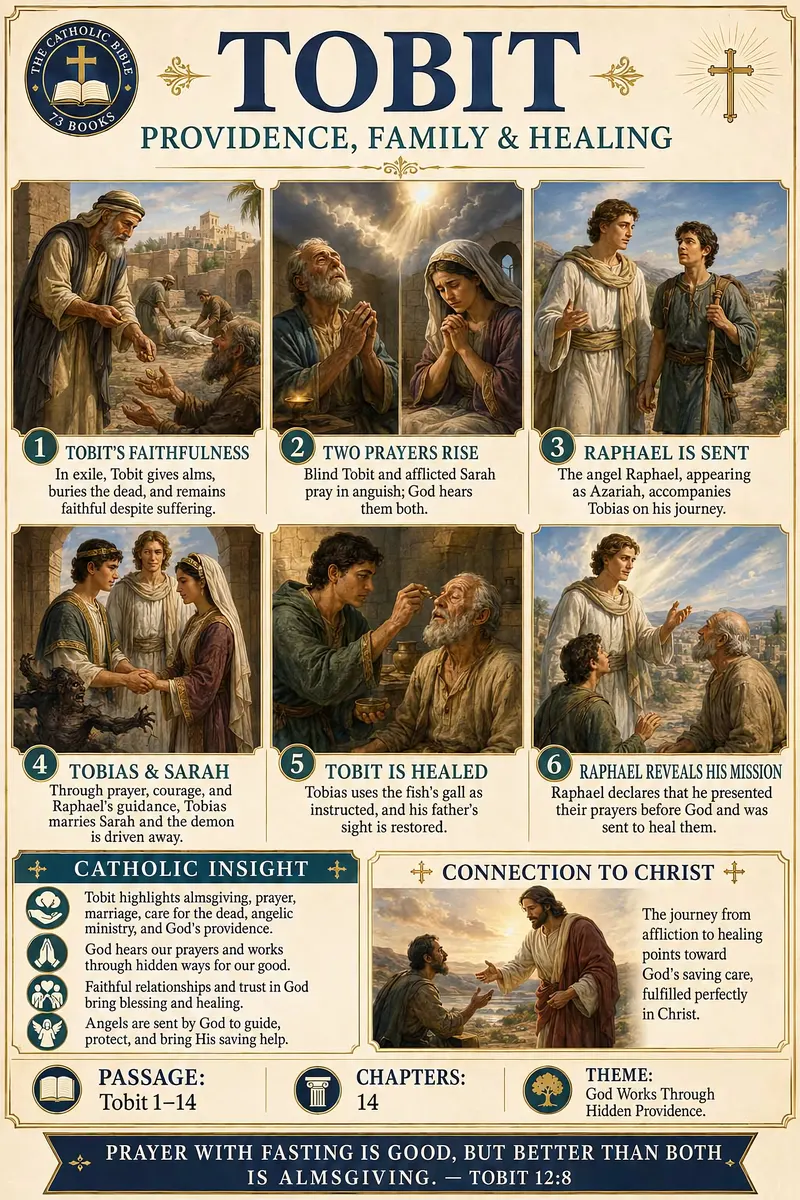
How can you study Judith with a printed page?
A single illustrated page helps you hold the five parts in mind: the threat, the siege, Judith's preparation, the night in the camp, and the song of thanksgiving. The Catholic Bible Maps kit has one illustrated page for each of the 73 books of the Catholic Bible, including Judith, so you can read the chapters and then check them against the page.
The kit is a reading companion. It does not replace your Bible.