
The Deuterocanonical Books: What They Are and Why the Catholic Bible Has 73
Short answer: The deuterocanonical books are seven Old Testament books in the Catholic Bible: Tobit, Judith, Wisdom, Sirach, Baruch, and 1 and 2 Maccabees, plus additional passages in Esther and Daniel. They are why Catholic Bibles have 73 books while most Protestant Bibles have 66.
What does "deuterocanonical" mean?
The word comes from Greek and means "second canon." Catholics use it for the Old Testament books and passages that were not part of the Hebrew Bible as it was later fixed, but were part of the Greek Old Testament (the Septuagint) that the early Church read widely. They are fully part of the Catholic Old Testament. The Catechism lists the canon as 46 books of the Old Testament and 27 of the New (CCC 120).
Which books are the deuterocanonical books?
| Book | Chapters | What it is |
|---|---|---|
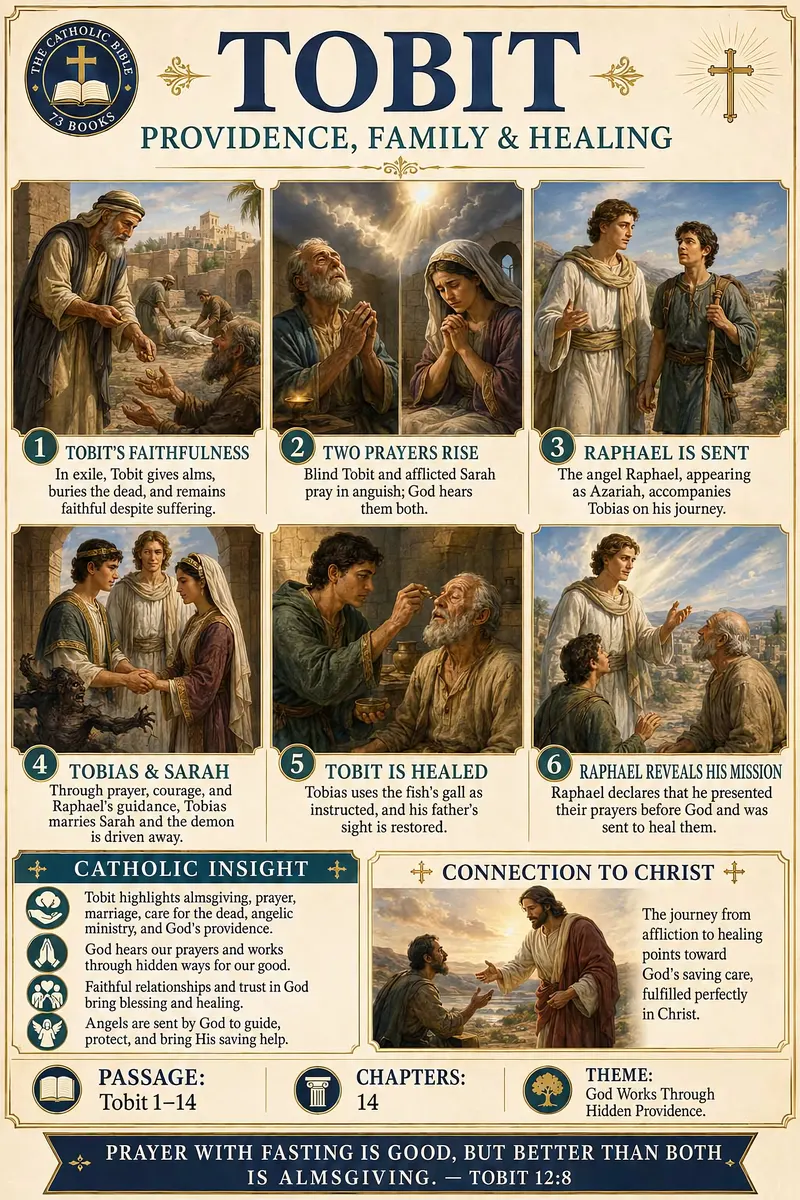
| Tobit | 14 | A family story set in exile in Nineveh: faithfulness, prayer, and the angel Raphael |
| Judith | 16 | A widow's courage during an Assyrian siege of her town |
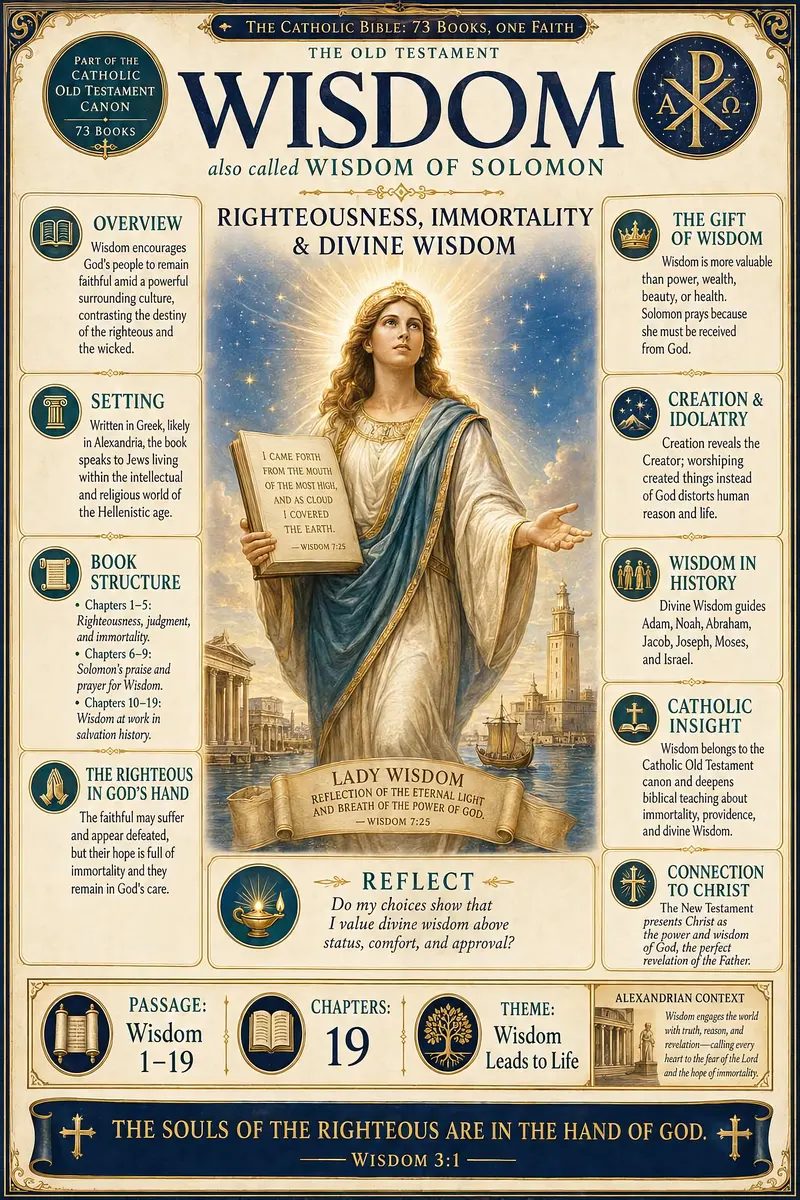
| Wisdom | 19 | Reflections on righteousness, suffering and Wisdom as a gift of God, written in Greek |
| Sirach | 51 | A long collection of practical teaching from Ben Sira, translated into Greek by his grandson |
| Baruch | 6 | Prayer and consolation for the exiles, attached to the prophet Jeremiah's scribe |
| 1 Maccabees | 16 | The Jewish revolt against persecution in the second century before Christ |
| 2 Maccabees | 15 | Stories of faithful martyrs and the hope of resurrection |
In addition, Catholic Bibles contain extra passages in two books that Protestant Bibles omit: the additions to Esther, and in Daniel the Prayer of Azariah and Song of the Three Young Men, Susanna, and Bel and the Dragon.
Why do Catholic Bibles have 73 books and others 66?
The difference is the Old Testament. Both Catholic and Protestant Bibles have the same 27 New Testament books. For the Old Testament, Protestant Bibles follow the Hebrew canon (39 books). The Catholic Church recognizes 46, and the historical path to that list runs like this:
- The Greek Old Testament, the Septuagint, was widely used among early Christians, and the New Testament often quotes it.
- Church councils in North Africa at Hippo (393) and Carthage (397) listed these books among the Scriptures.
- The Council of Trent defined the canon in 1546, in response to the Reformation, confirming the list Catholics use today.
- Many early Protestant Bibles, including the 1611 King James Version, printed these books in a separate section titled "Apocrypha," before they were gradually dropped from most editions.
The Eastern Orthodox churches also receive these books, with some differences in the exact list. So the Catholic list is not an outlier among the ancient churches, and Jewish and Protestant traditions follow the Hebrew canon.
Are the deuterocanonical books "apocrypha"?
In Catholic usage, no. Catholics reserve "apocrypha" for ancient writings that are not in the canon, such as some non-biblical gospels. Many Protestants use "Apocrypha" for the seven books discussed here, which is a source of confusion in online searches. If you see a Bible called "with the Apocrypha," check the contents rather than the label.
Where do you meet these books in Catholic life?
- At Mass: passages from Wisdom and Sirach appear in the readings, for example in funeral and wedding readings.
- In the Liturgy of the Hours: the Divine Office includes canticles and readings from these books.
- In the Catechism: for instance, the Church's tradition of praying for the dead is connected to 2 Maccabees 12:46 (CCC 1032).
- In history: 1 Maccabees 4 recounts the rededication of the Temple, which Jews commemorate in Hanukkah.
What are the best-known verses in these books?
- Tobit 12:8: the angel Raphael teaches that prayer joined with fasting is good, and that almsgiving with righteousness is better than wealth gathered unjustly.
- Wisdom 3:1: the souls of the righteous are "in the hand of God," and no torment will touch them.
- Sirach 44:1: the opening of a long hymn to the ancestors of Israel, rendered "Let us now praise famous men" in the Revised Standard Version.
- 2 Maccabees 7: the account of a mother and her seven sons who remain faithful under persecution, with a clear hope of resurrection.
Translations word these verses differently, so check your own Bible before quoting.
Which Bible includes all of them?
Look for a Bible labeled Catholic, such as the New American Bible, Revised Edition, the Revised Standard Version, Catholic Edition, or the Douay-Rheims. Open the table of contents and look for Tobit, Judith, Wisdom, Sirach, Baruch and 1 and 2 Maccabees. If all seven are there, you have the complete Old Testament. The USCCB hosts the New American Bible online, with every book of the 73 listed.
How should you start reading them?
Start with the short, story-driven books before the long wisdom collections:
- Tobit: fourteen chapters you can read in one sitting. It is a good first step because it reads like a story.
- Judith: a tight narrative with a clear beginning, middle and end.
- Wisdom: slower and more reflective; read a chapter a day.
- Sirach: dip in by topic (friendship, speech, prayer, family) rather than front to back.
- 1 and 2 Maccabees: read with a map, because the places and the dates matter.
- Baruch: short, and a good companion to Jeremiah and Lamentations.
For a quick view of any one of them, a one-page overview helps. We explain how to make one in our Bible mind map guide, and the full list of books is in The 73 Books of the Catholic Bible.
Where can you see all seven on one page each?
The Catholic Bible Maps guide includes an illustrated one-page map for each deuterocanonical book, with overview, structure, key verses and the book's connection to Christ. The Tobit and Wisdom pages above are from it.