
1 and 2 Maccabees Summary for Catholics: The Story, the Martyrs and Prayer for the Dead
Short answer: First and Second Maccabees are two Old Testament books about the Jewish resistance to King Antiochus IV Epiphanes in the second century B.C. First Maccabees tells the revolt of Mattathias and his sons and the Temple rededication behind Hanukkah. Second Maccabees tells of martyrs and of Judas praying for the dead. Both are deuterocanonical books of the Catholic Bible.
Bible text and notes checked against the New American Bible on the USCCB site.
What are 1 and 2 Maccabees about?
First and Second Maccabees tell how faithful Jews resisted a pagan king who tried to wipe out their worship in the second century B.C.
The USCCB introduction says the two books "contain independent accounts of events (in part identical)" from that crisis.
According to the USCCB, the name Maccabee probably means "hammer." In the books it belongs to one man, Judas, the third son of the priest Mattathias.
What happens in 1 Maccabees?
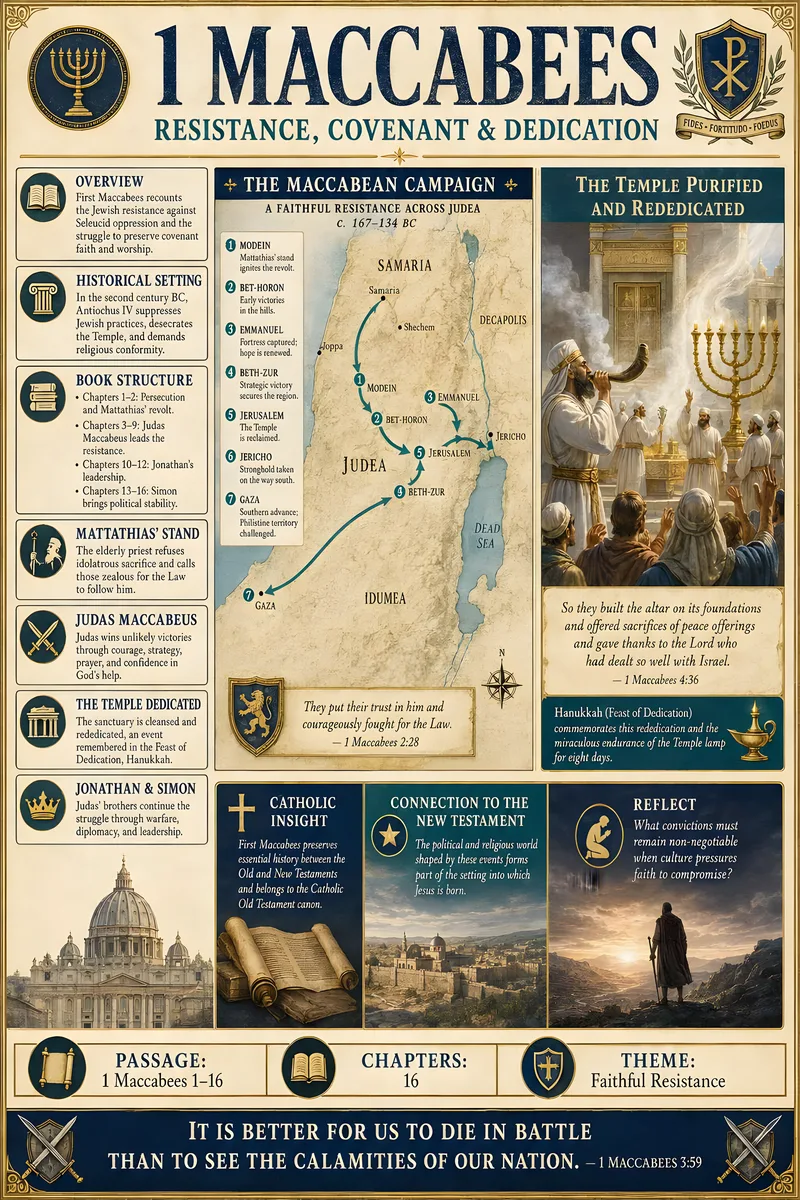
The book opens with Alexander the Macedonian, who defeated Darius, king of the Persians and Medes (1:1). A few verses later comes "a sinful offshoot, Antiochus Epiphanes" (1 Maccabees 1:10).
Antiochus enters the sanctuary in Jerusalem and takes away the golden altar and the lampstand (1:21). On the fifteenth day of Kislev, "the king erected the desolating abomination upon the altar of burnt offerings" (1:54).
Many refused to give in: "they preferred to die rather than to be defiled with food or to profane the holy covenant; and they did die" (1:63).
In chapter 2 the priest Mattathias leaves Jerusalem for Modein with his five sons: John, Simon, Judas, Eleazar and Jonathan (2:1 to 5). When the king's officers demand a pagan sacrifice, he cries out: "Let everyone who is zealous for the law and who stands by the covenant follow me!" (2:27).
The USCCB divides the book into four parts:
- Crisis and Response (1:1 to 2:70). The persecution and the revolt of Mattathias.
- Leadership of Judas Maccabeus (3:1 to 9:22). Judas wins battles and purifies the Temple.
- Leadership of Jonathan (9:23 to 12:53). His brother Jonathan carries on the struggle.
- Leadership of Simon (13:1 to 16:24). Another brother, Simon, leads the people.
According to the USCCB, 1 Maccabees was written about 100 B.C. in Hebrew. The Hebrew original is lost. What survives is "an early, pre-Christian, Greek translation." It covers the years from 175 to 134 B.C.
How is the Temple rededication connected to Hanukkah and to Jesus?
After their victories, Judas and his brothers say: "let us go up to purify the sanctuary and rededicate it" (1 Maccabees 4:36). They build a new altar and light the lamps again (4:47 to 50).
The new altar is used on the twenty-fifth day of Kislev (4:52). "For eight days they celebrated the dedication of the altar" (4:56). Then they decree that these days be kept every year "with joy and gladness" (4:59).
The USCCB note says this rededication "is the origin of the Jewish feast of Hanukkah."
Jesus himself was in the Temple for this feast. John 10:22 says: "The feast of the Dedication was then taking place in Jerusalem. It was winter." The USCCB note on that verse calls it "an eight-day festival of lights (Hebrew, Hanukkah) held in December" and dates the rededication to 164 B.C.
How is 2 Maccabees different from 1 Maccabees?
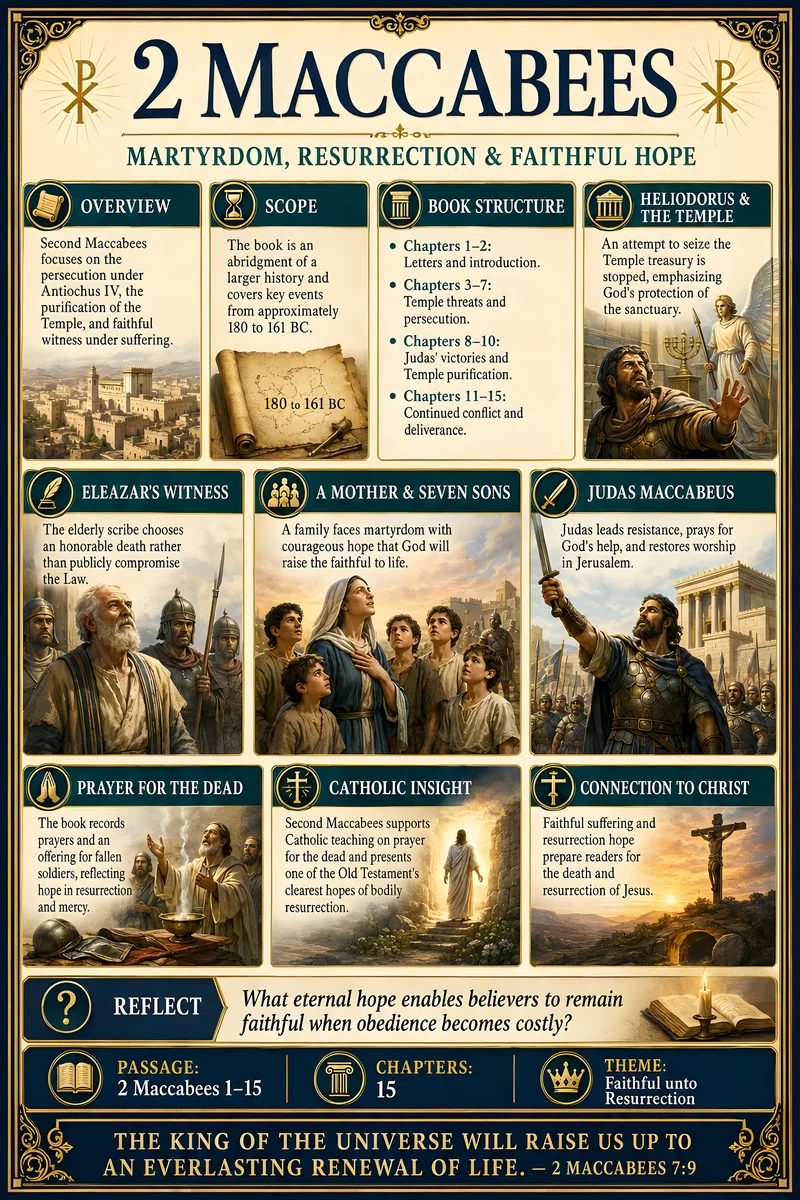
Second Maccabees is shorter, with 15 chapters, and it says openly that it is a summary. "All this, detailed by Jason of Cyrene in five volumes, we will try to condense into a single book" (2 Maccabees 2:23).
A few differences worth knowing:
- It opens with letters. Chapter 1 begins with a letter from the Jews in Jerusalem to the Jews in Egypt.
- It covers fewer years. It tells of the campaigns "against Antiochus Epiphanes and his son Eupator" (2:20).
- It teaches more openly about the life to come. The USCCB says 1 Maccabees has no doctrine of individual immortality, "unlike the Second Book of Maccabees."
Who are the martyrs of 2 Maccabees?
Chapter 6 tells of Eleazar, "one of the foremost scribes" (6:18). He is told to pretend to eat pork and refuses. He says that if he gave in, "many of the young would think the ninety-year-old Eleazar had gone over to an alien religion" (6:24). The book says he left "a model of nobility and an unforgettable example of virtue" (6:31).
Chapter 7 tells of seven brothers and their mother. The second says with his last breath: "the King of the universe will raise us up to live again forever, because we are dying for his laws" (7:9). The fourth says: "It is my choice to die at the hands of mortals with the hope that God will restore me to life" (7:14).
The mother is called "most admirable and worthy of everlasting remembrance" (7:20). She tells her youngest son to look at heaven and earth, "then you will know that God did not make them out of existing things" (7:28).
The Catechism quotes the mother in paragraph 297, on creation "out of nothing." It quotes the brothers in paragraph 992, which says that "God revealed the resurrection of the dead to his people progressively."
Why do Catholics pray for the dead because of 2 Maccabees?
In 2 Maccabees 12, Judas and his men go to bury fallen soldiers. Under their tunics they find amulets of idols, which the law forbade (12:40).
So they pray "that the sinful deed might be fully blotted out" (12:42). Judas sends two thousand silver drachmas to Jerusalem "to provide for an expiatory sacrifice" (12:43). The text explains why: "for if he were not expecting the fallen to rise again, it would have been superfluous and foolish to pray for the dead" (12:44). It ends: "Thus he made atonement for the dead that they might be absolved from their sin" (12:46).
The USCCB note calls this "the earliest statement of the doctrine that prayers (v. 42) and sacrifices (v. 43) for the dead are efficacious." It adds that the belief is "similar to, but not quite the same as, the Catholic doctrine of purgatory."
The Catechism cites this passage in paragraph 1032, where it says that the teaching on purgatory "is also based on the practice of prayer for the dead, already mentioned in Sacred Scripture."
Why are 1 and 2 Maccabees in the Catholic Bible but not in most Protestant Bibles?
The USCCB introduction says Jews and Protestants regard the two books as apocryphal, because they are not in the Jewish list of books drawn up at the end of the first century A.D. But they "have always been accepted by the Catholic Church as inspired."
The Catechism lists "1 and 2 Maccabees" among the books of the Old Testament in paragraph 120. They are two of the seven deuterocanonical books.
How can you keep the Maccabees story straight while you read?
The two books have many names, battles and dates. A one-page overview of each helps you see who is who.
The Catholic Bible Maps kit has one illustrated page for each of the 73 books of the Catholic Bible, including 1 Maccabees and 2 Maccabees.
The kit is a reading companion. It does not replace your Bible.
Sources
- USCCB, New American Bible: Introduction to 1 Maccabees
- USCCB, New American Bible: 1 Maccabees, chapter 1
- USCCB, New American Bible: 1 Maccabees, chapter 2
- USCCB, New American Bible: 1 Maccabees, chapter 4
- USCCB, New American Bible: 2 Maccabees, chapter 1
- USCCB, New American Bible: 2 Maccabees, chapter 2
- USCCB, New American Bible: 2 Maccabees, chapter 6
- USCCB, New American Bible: 2 Maccabees, chapter 7
- USCCB, New American Bible: 2 Maccabees, chapter 12
- USCCB, New American Bible: John, chapter 10
- Catechism of the Catholic Church, paragraph 120
- Catechism of the Catholic Church, paragraph 297
- Catechism of the Catholic Church, paragraph 992
- Catechism of the Catholic Church, paragraph 1032