
Book of Baruch Summary for Catholics: Confession, Wisdom and the Road Home
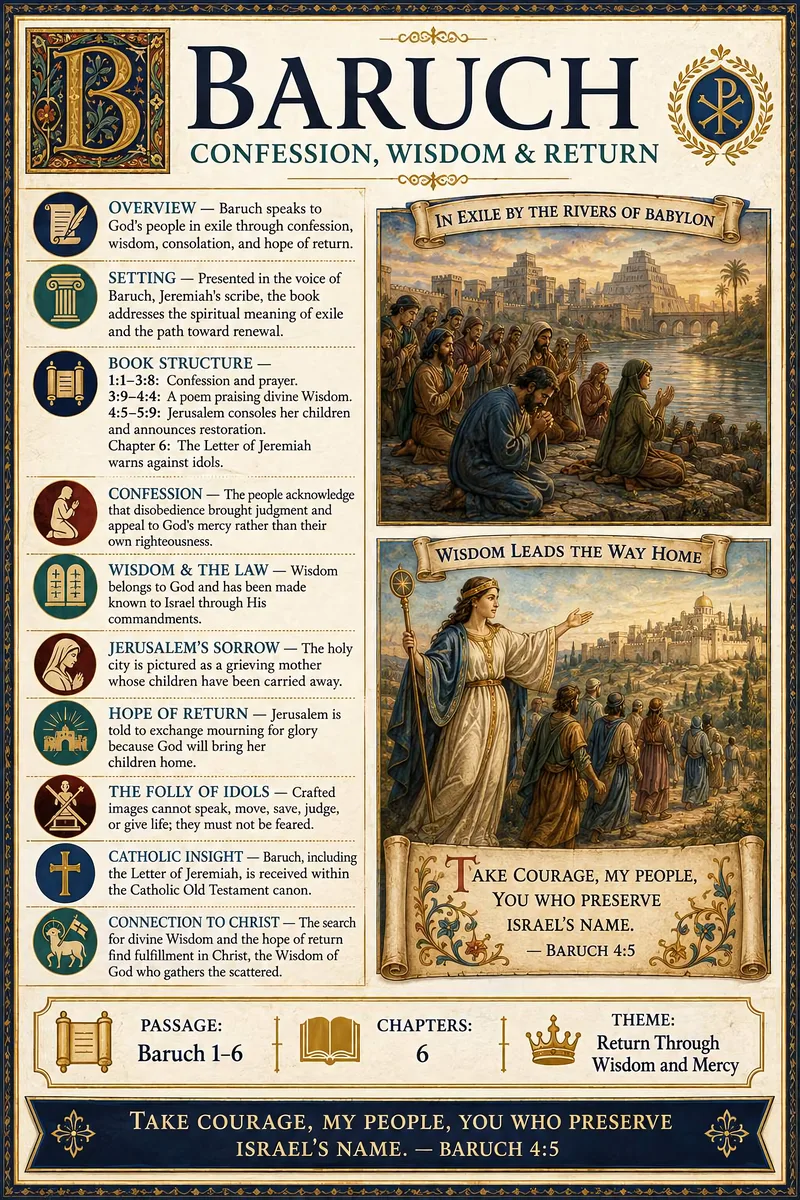
Short answer: The Book of Baruch is a short deuterocanonical book of the Catholic Bible, set among the exiles in Babylon and linked to Jeremiah's scribe. It has four parts: a confession and prayer for mercy, a poem on Wisdom, a consolation promising Jerusalem her children will return, and the Letter of Jeremiah against idols.
Bible text and notes checked against the New American Bible on the USCCB site.
What is the Book of Baruch about?
Baruch is a short Old Testament book of six chapters, written for God's people in exile. It moves from confession of sin, to praise of Wisdom, to a promise that the exiles will come home.
The opening verses name Baruch, son of Neriah, as the one who wrote the scroll "in Babylon" (Baruch 1:1). The USCCB introduction explains that this is the well-known assistant to the prophet Jeremiah (Jeremiah 32:12; 36:4).
The same introduction calls the book "a collection of four very different compositions." It says the original language may have been Hebrew, "but only the Greek and other versions have been preserved."
How is the Book of Baruch organized?
The USCCB divides the book into four parts:
- Letter to Jerusalem (1:1 to 3:8). The setting in Babylon, a confession of guilt and a prayer for deliverance.
- Praise of Wisdom (3:9 to 4:4). A poem on where true wisdom is found.
- Baruch's Poem of Consolation (4:5 to 5:9). Jerusalem mourns her children, then hears that they will return.
- Letter of Jeremiah (6:1 to 72). A warning against idols.
The introduction adds that the book explains the exile through a familiar pattern: "sin (of Israel), punishment, repentance, and return."
What happens in the first part of Baruch?
Baruch reads his scroll "in the hearing of Jeconiah, son of Jehoiakim, king of Judah," and of all the exiles who lived "by the river Sud" (1:3 to 4).
The people respond with their whole hearts: "They wept, fasted, and prayed before the Lord" (1:5). They collect what money they can and send it to the priests in Jerusalem (1:6 to 7).
With the money comes a humble request: "Pray for us to the LORD, our God, for we have sinned against the LORD, our God" (1:13).
The prayer of the exiles closes in chapter 3 with these words: "Hear, LORD, and have mercy, for you are a merciful God; have mercy on us, who have sinned against you" (3:2).
The USCCB introduction notes that this prayer "is a confession of sin and a request for mercy," with "remarkable similarities" to Daniel 9 and to parts of Jeremiah.
What does Baruch teach about Wisdom?
The second part begins with a call: "Hear, Israel, the commandments of life: listen, and know prudence!" (3:9).
Then comes a hard question. Why is Israel "grown old in a foreign land"? The answer is direct: "You have forsaken the fountain of wisdom!" (3:10, 12).
The poem says that God "has uncovered the whole way of understanding, and has given her to Jacob, his servant" (3:37). It continues: "Thus she has appeared on earth, is at home with mortals" (3:38).
Chapter 4 names where that wisdom is found: "She is the book of the precepts of God, the law that endures forever" (4:1). The USCCB note says this poem "identifies wisdom and law," as Sirach 24:22 to 23 also does.
Sirach is another wisdom book of the Catholic Bible. Our Book of Sirach summary gives an overview of it.
Why is Baruch 5 read during Advent?
Baruch 4 and 5 picture Jerusalem as a mother. In chapter 4 she says to her children: "With mourning and lament I sent you away" (4:23). Then she encourages them: "Take courage, my children; call upon God" (4:21).
Chapter 5 turns her grief to joy:
- "Jerusalem, take off your robe of mourning and misery; put on forever the splendor of glory from God" (5:1).
- "Rise up, Jerusalem! stand upon the heights; look to the east and see your children" (5:5).
- "God has commanded that every lofty mountain and the age-old hills be made low, that the valleys be filled to make level ground" (5:7).
The USCCB cross reference for verse 7 points to Isaiah 40:3 to 4. That is the same passage John the Baptist fulfills in Luke 3, where we read: "Every valley shall be filled and every mountain and hill shall be made low" (Luke 3:5).
The Church puts the two texts side by side. On the Second Sunday of Advent, Sunday, December 8, 2024, the first reading was Baruch 5:1 to 9 and the Gospel was Luke 3:1 to 6 (USCCB daily readings, Lectionary 6).
Read together, the exiles waiting to come home and the voice crying out in the desert both point to the coming of the Lord.
What is the Letter of Jeremiah in Baruch 6?
The last chapter is "A copy of the letter which Jeremiah sent to those led captive to Babylon" (6:1). The USCCB introduction says it "circulated separately in major manuscripts of the Greek tradition."
The letter warns the exiles about the idols they will see in Babylon, "gods of silver and gold and wood, carried shoulder high" (6:3). It tells them to say in their hearts: "You, Lord, are the one to be worshiped!" (6:5).
According to the USCCB introduction, the letter contains ten warnings that end in a kind of refrain. One example: "Thus it is known they are not gods; do not fear them" (6:14).
Is Baruch in the Catholic Bible?
Yes. The Catechism lists Baruch among the books of the Old Testament in paragraph 120.
It is one of the seven deuterocanonical books, so you will find it in a Catholic Bible but not in most Protestant Bibles.
The Catechism also explains why Catholics read books like this one with Christ in mind. When the Church reads the Old Testament, "she searches there for what the Spirit, 'who has spoken through the prophets,' wants to tell us about Christ" (CCC 702).
How can you read Baruch this Advent?
Baruch has only six chapters, so you can read it in four short sittings:
- Day 1: chapters 1 to 3:8, the confession and prayer.
- Day 2: chapters 3:9 to 4:4, the poem on Wisdom.
- Day 3: chapters 4:5 to 5:9, the consolation of Jerusalem.
- Day 4: chapter 6, the Letter of Jeremiah.
Before you start, it helps to see the whole book on one page. The Catholic Bible Maps kit has one illustrated page for each of the 73 books of the Catholic Bible, including Baruch and Lamentations.
The kit is a reading companion. It does not replace your Bible.
Sources
- USCCB, New American Bible: Introduction to Baruch
- USCCB, New American Bible: Baruch, chapter 1
- USCCB, New American Bible: Baruch, chapter 3
- USCCB, New American Bible: Baruch, chapter 4
- USCCB, New American Bible: Baruch, chapter 5
- USCCB, New American Bible: Baruch, chapter 6
- USCCB, New American Bible: Luke, chapter 3
- USCCB Daily Readings: Second Sunday of Advent, December 8, 2024
- Catechism of the Catholic Church, paragraph 120
- Catechism of the Catholic Church, paragraph 702