
Book of Sirach Summary for Catholics: Who Wrote It, Key Verses and Why It Is in the Bible
Short answer: The Book of Sirach, also called Ecclesiasticus, is a 51-chapter Old Testament book of practical wisdom. It was written in Hebrew by Jesus, son of Eleazar, son of Sira, and finished around 175 B.C. It teaches that the fear of the Lord is the beginning of wisdom. It is one of the seven deuterocanonical books of the Catholic Bible.
Bible text and notes checked against the New American Bible on the USCCB site.
What is the Book of Sirach about?
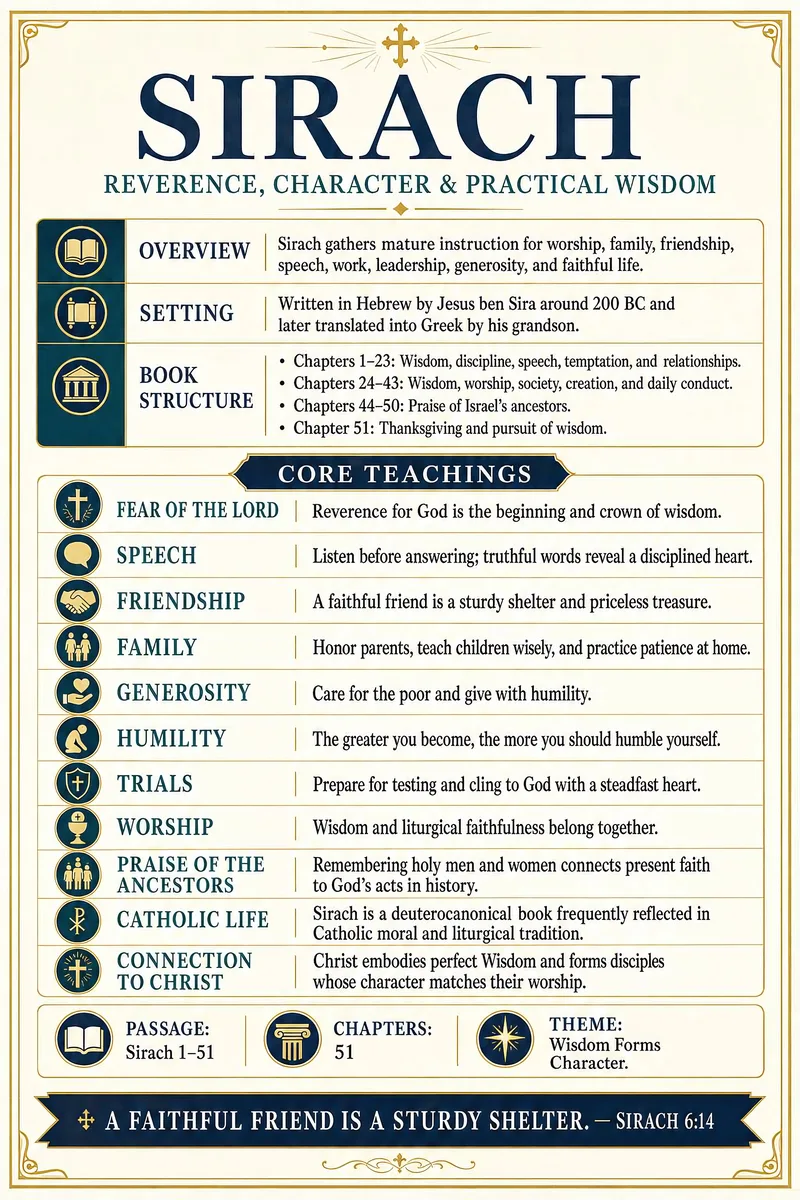
Sirach is a book of practical wisdom in the Old Testament. It has 51 chapters of short sayings about God, family, friends, speech, money and prayer.
The USCCB introduction says the book contains "numerous well-crafted maxims, grouped by affinity." It deals with "the individual, the family, and the community in their relations with one another and with God."
Topics you will meet as you read:
- friendship and how to test it;
- education and discipline;
- poverty and wealth;
- laws and religious worship.
Who wrote Sirach, and why is it also called Ecclesiasticus?
The author names himself near the end: "Yeshua [Jesus], son of Eleazar, son of Sira" (50:27). The name "Sirach" comes from the Greek form of his name.
The USCCB describes him as a sage who lived in Jerusalem. He loved the wisdom tradition, the law, the priesthood, the Temple and divine worship. He wrote to help his people keep their faith through study of their sacred books.
The other title, "Liber Ecclesiasticus," means "Church Book." The USCCB says this is perhaps due to "the extensive use the church made of this book in presenting moral teaching to catechumens and to the faithful."
When was Sirach written?
According to the USCCB introduction:
- It was written in Hebrew in the early years of the second century B.C. and finished around 175 B.C.
- The author's grandson translated it into Greek after 117 B.C. He also wrote a foreword, which is still printed with the book.
- For centuries Christians knew it mainly in Greek and Latin. Hebrew manuscripts were then found between 1896 and 1900, in 1931, and several times since 1956. Today more than two thirds of the Hebrew text is available.
- One of these Hebrew texts, found at Masada, is older than the time of Christ.
How is the Book of Sirach organized?
The USCCB notes that the book is "not easily divided into separate parts." Still, it gives a simple outline:
- Chapters 1 to 43: mostly moral instruction.
- Chapters 44:1 to 50:24: praise of the heroes of Israel.
- Chapter 51: two appendixes, a prayer of thanks to God (51:1 to 12) and an invitation to the unschooled to seek true wisdom (51:13 to 30).
Because the sayings are short, Sirach is easy to read a little at a time, one chapter a day or even a few verses at morning prayer.
What does Sirach teach about the fear of the Lord?
The book opens with the source of all wisdom: "All wisdom is from the Lord and remains with him forever" (1:1).
Then it repeats one idea in several ways. "The beginning of wisdom is to fear the Lord" (1:14). "The fullness of wisdom is to fear the Lord" (1:16). "The crown of wisdom is the fear of the Lord" (1:18).
For Sirach, this fear is not panic. It is reverence that shows itself in obedience: "If you desire wisdom, keep the commandments, and the Lord will bestow her upon you" (1:26).
What does Sirach say about trusting God in hard times?
Chapter 2 is a favorite for anyone carrying a heavy load. It begins: "My child, when you come to serve the Lord, prepare yourself for trials" (2:1).
It continues with a picture many readers remember: "For in fire gold is tested, and the chosen, in the crucible of humiliation" (2:5). And then a simple promise of hope in God: "Trust in God, and he will help you" (2:6).
Sirach also invites us to look back over history: "has anyone trusted in the Lord and been disappointed?" (2:10). The reason, the next verse says, is that "the Lord is compassionate and merciful" (2:11).
What does Sirach teach about family and caring for aging parents?
Chapter 3 speaks about honoring father and mother. "Those who honor their father atone for sins; they store up riches who respect their mother" (3:3 to 4).
It speaks with tenderness about parents in old age: "Even if his mind fails, be considerate of him; do not revile him because you are in your prime" (3:13).
The Catechism of the Catholic Church quotes this passage (Sir 3:2 to 6 and 3:12 to 13, 16) in paragraph 2218. There it explains that the fourth commandment reminds grown children to give their parents "material and moral support in old age and in times of illness, loneliness, or distress."
The same chapter also teaches humility: "Humble yourself the more, the greater you are, and you will find mercy in the sight of God" (3:18).
What does Sirach say about friendship?
Chapter 6 holds some of the best known lines in the book. It advises care: "When you gain friends, gain them through testing, and do not be quick to trust them" (6:7).
Then it praises the friend who stays: "Faithful friends are a sturdy shelter; whoever finds one finds a treasure" (6:14). And: "Faithful friends are life-saving medicine; those who fear God will find them" (6:16).
These verses are often a good start for a women's Bible study or a note to a friend who has stood by you.
Why is Sirach in the Catholic Bible but not in Protestant Bibles?
The USCCB introduction explains that Sirach was not included in the Jewish Bible after the first century A.D., "nor, therefore, accepted by Protestants." But it "has been recognized by the Catholic Church as inspired and canonical."
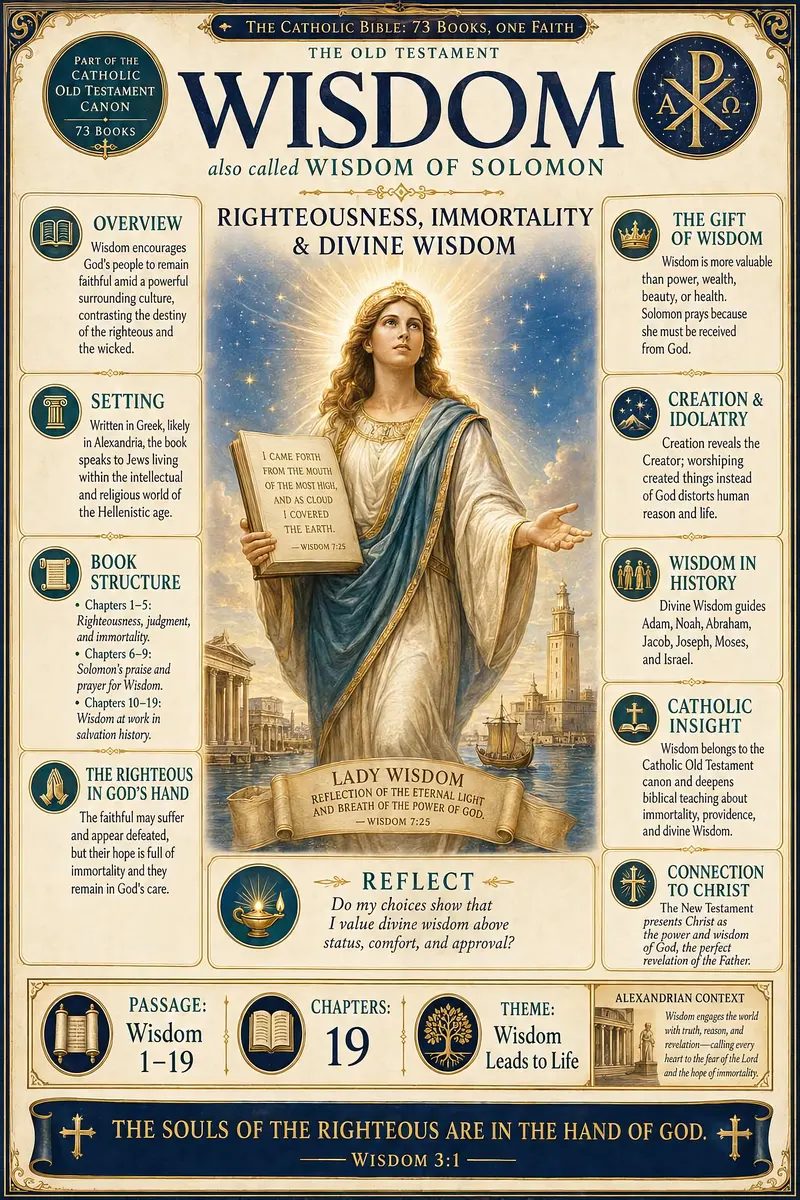
The Catechism of the Catholic Church (120) lists "Sirach (Ecclesiasticus)" among the books of the Old Testament canon, right after the Wisdom of Solomon. It is one of the seven deuterocanonical books. For the full list, see our guide to the deuterocanonical books, or read the Book of Judith summary for another of the seven.
How can you read Sirach with a printed page beside you?
Since Sirach has no single story, many readers lose track of where they are. A one-page overview helps: the opening on the fear of the Lord, the long middle of practical advice, the praise of the ancestors, and the closing prayer.
The Catholic Bible Maps kit has one illustrated page for each of the 73 books of the Catholic Bible, including Sirach and Wisdom. You can read a chapter, then look at the page to see where it fits.
The kit is a reading companion. It does not replace your Bible.
Sources
- USCCB, New American Bible: Introduction to the Wisdom of Ben Sira
- USCCB, New American Bible: Sirach, chapter 1
- USCCB, New American Bible: Sirach, chapter 2
- USCCB, New American Bible: Sirach, chapter 3
- USCCB, New American Bible: Sirach, chapter 6
- USCCB, New American Bible: Sirach, chapter 51
- Catechism of the Catholic Church, paragraph 120
- Catechism of the Catholic Church, paragraph 2218 and notes