
Book of Wisdom Summary for Catholics: Who Wrote It, Key Verses and Why It Matters
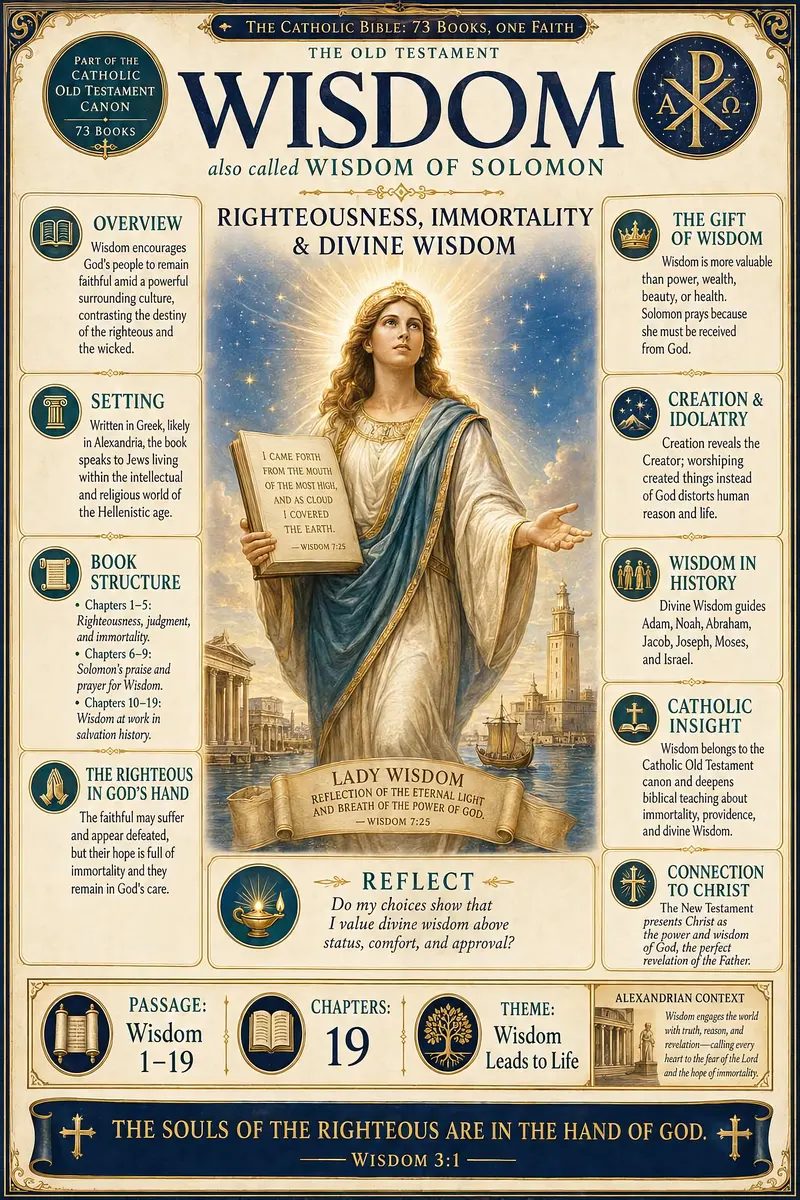
Short answer: The Book of Wisdom, also called the Wisdom of Solomon, is a 19-chapter Old Testament book written in Greek about fifty years before Christ, probably in Alexandria, Egypt. It praises divine wisdom, teaches that God gives immortality to the righteous, and retells the exodus. It is one of the seven deuterocanonical books of the Catholic Bible.
Bible text and notes checked against the New American Bible on the USCCB site.
What is the Book of Wisdom about?
The Book of Wisdom, also called the Wisdom of Solomon, is an Old Testament book of 19 chapters. It praises the wisdom that comes from God and teaches how God rewards the righteous.
The USCCB introduction lists the main themes the author used:
- the splendor and worth of divine wisdom (6:22 to 11:1);
- the glorious events of the exodus;
- God's mercy (11:17 to 12:22);
- the folly of idolatry (13:1 to 15:17);
- how God's justice rewards or punishes each person (1:1 to 6:21).
The author wrote to strengthen fellow believers "in a time when they had experienced suffering and oppression," as the USCCB puts it.
Who wrote the Book of Wisdom, and when?
The author's name is not known. The USCCB introduction says he was "probably a member of the Jewish community at Alexandria, in Egypt." He wrote in Greek, in a style patterned on Hebrew verse.
The book was written "about fifty years before the coming of Christ." The USCCB places its author, like Ben Sira, among the sages of postexilic Judaism.
Why is it called the Wisdom of Solomon? At times the author "speaks in the person of Solomon." He places his teaching on the lips of the wise king of Hebrew tradition to show its value. Chapter 9 is his version of Solomon's prayer for wisdom, the prayer you also find in 1 Kings 3.
How is the Book of Wisdom organized?
The USCCB gives three main parts:
- The Reward of Righteousness (1:1 to 6:21). The righteous and the wicked are set side by side. The reward of the righteous is immortality, a gift from God.
- Praise of Wisdom by Solomon (6:22 to 11:1). Solomon tells how he prayed for wisdom and loved her more than riches, health and beauty.
- God's Providence During the Exodus (11:2 to 19:22). The author retells the exodus, with two side discussions: one on God's mercy and one on the folly of idolatry.
A tip for first-time readers: chapters 1 to 9 are the easiest place to start. They include 3:1 to 8, a passage the Church uses in the liturgy.
What are the key verses in the Book of Wisdom?
Here are five passages worth marking in your Bible. The wording is from the New American Bible.
- Wisdom 1:13. "Because God did not make death, nor does he rejoice in the destruction of the living."
- Wisdom 2:23 to 24. "For God formed us to be imperishable; the image of his own nature he made us. But by the envy of the devil, death entered the world."
- Wisdom 3:1. "The souls of the righteous are in the hand of God, and no torment shall touch them."
- Wisdom 7:7. "Therefore I prayed, and prudence was given me; I pleaded and the spirit of Wisdom came to me."
- Wisdom 9:4. "Give me Wisdom, the consort at your throne, and do not reject me from among your children."
The Catechism quotes the first two together in paragraph 413: "God did not make death, and he does not delight in the death of the living. . . It was through the devil's envy that death entered the world."
Why do Catholics hear Wisdom 3 at funerals?
The USCCB introduction notes that many passages from the first part of the book, notably 3:1 to 8, "are used by the church in the liturgy."
Read those verses slowly and you will see why. To the foolish, the righteous "seemed" to be dead, "But they are in peace." Their "hope full of immortality." God tried them "As gold in the furnace" and "found them worthy of himself."
The USCCB note on 3:1 to 12 explains the point: for the righteous, sufferings "are not punishments but purification and opportunities to show fidelity." For anyone who has buried a parent or a spouse, this chapter gives words of hope rooted in Scripture.
Does the Book of Wisdom point to Jesus?
The USCCB introduction says the first ten chapters "provide background for the teaching of Jesus and for some New Testament theology about Jesus."
Two places stand out:
- Wisdom 2:12 to 20. The wicked plot against "the righteous one," who "boasts that God is his Father." They say: "For if the righteous one is the son of God, God will help him and deliver him from the hand of his foes." It is worth reading next to the Passion accounts in the Gospels.
- Wisdom 7:26. Wisdom is "the reflection of eternal light, the spotless mirror of the power of God, the image of his goodness." The USCCB note points out that this language is used in Hebrews 1:3 and Colossians 1:15, two letters that speak of Christ.
What does Wisdom teach about seeing God in creation?
Chapter 13 says people should have found the Creator through the beauty of the world: "For from the greatness and the beauty of created things their original author, by analogy, is seen" (13:5).
The Catechism makes the same point in paragraph 41: "from the greatness and beauty of created things comes a corresponding perception of their Creator."
The same chapter then turns to idols. It describes a carpenter who carves a scrap of wood, nails it to the wall, and then prays to it "about his goods or marriage or children" (13:17). The lesson is simple: a made thing cannot save the one who made it.
Why is the Book of Wisdom in the Catholic Bible but not in most Protestant Bibles?
Wisdom is one of the seven deuterocanonical books. The Catechism lists "the Wisdom of Solomon" among the 46 books of the Old Testament in paragraph 120. Most Protestant Bibles do not count it among the Old Testament books.
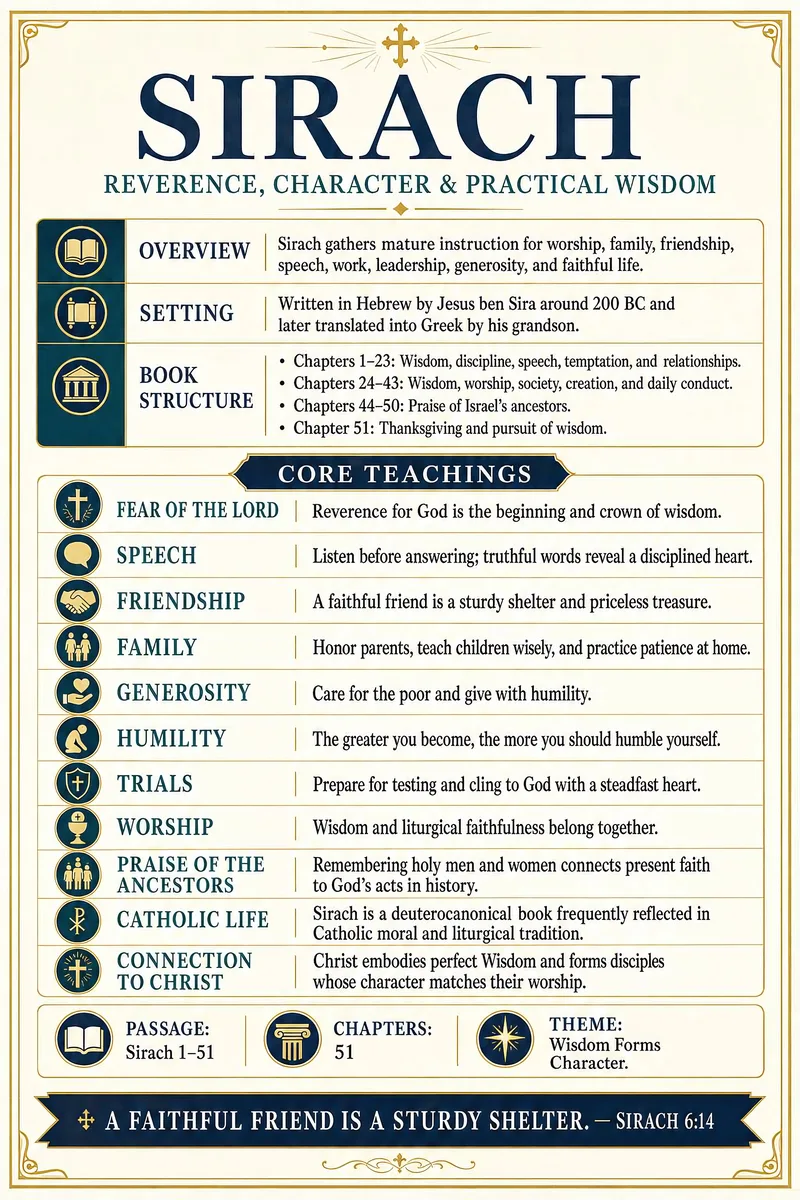
To see the full list and the reasons, read our guide to the deuterocanonical books. If you liked Wisdom, the Book of Sirach summary covers the book that follows it in the Catholic Bible.
How can you read the Book of Wisdom with a guide beside you?
Wisdom moves from the fate of the righteous, to Solomon's prayer, to a long retelling of the exodus. A one-page overview helps you keep those three parts in view while you read.
The Catholic Bible Maps kit has one illustrated page for each of the 73 books of the Catholic Bible, including Wisdom and Sirach. Read a chapter, then look at the page to see where it fits.
The kit is a reading companion. It does not replace your Bible.
Sources
- USCCB, New American Bible: Introduction to the Book of Wisdom
- USCCB, New American Bible: Wisdom, chapter 1
- USCCB, New American Bible: Wisdom, chapter 2
- USCCB, New American Bible: Wisdom, chapter 3
- USCCB, New American Bible: Wisdom, chapter 7
- USCCB, New American Bible: Wisdom, chapter 9
- USCCB, New American Bible: Wisdom, chapter 13
- Catechism of the Catholic Church, paragraph 41
- Catechism of the Catholic Church, paragraph 120
- Catechism of the Catholic Church, paragraph 413